Actualité, News
Publié : 1 October 2026
I Mis à jour : 9 October 2026
[FRB-CESAB] Newsletter 15 CESAB – September 2026
The FRB’s Center for Biodiversity Synthesis and Analysis (CESAB) is a research structure with an international scope whose objective is to implement innovative work on the synthesis and analysis of existing data sets in the field of biodiversity. Twice a year, the CESAB publishes a newsletter listing the different news and activities going on.
A few words from Denis Couvet, Chair of the FRB
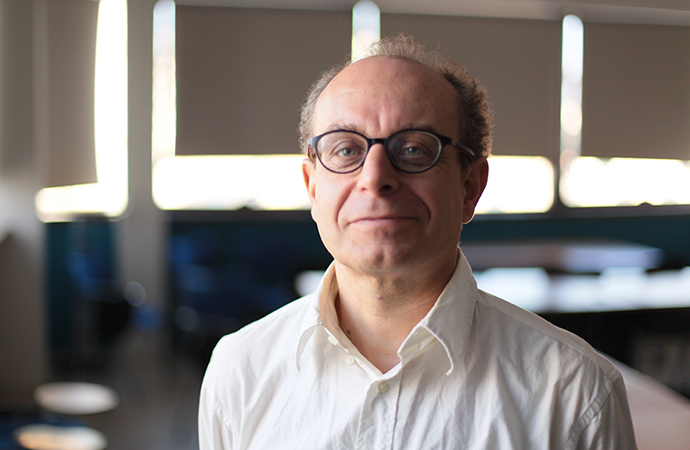
The scientific and organisational excellence of the CESAB is a valuable asset for French, European and global research. Its recognised strengths have earned it a significant role in the Priority Research Programmes and Equipment (PEPRs) SOLU-BIOD and DYNA-BIOD, hosting working groups and providing a supportive framework for cutting-edge research. The FRB will work to facilitate synergies between these two programmes, which are clearly relevant to one another but whose potential for convergence remains largely untapped.
One of the key challenges ahead for the CESAB, both societal and scientific, will be to move beyond our “biodiversity” silos. This is what IPBES recommends in its Nexus Assessment, which emphasises the need to bring together the fields of biodiversity, water, climate, food and health. The assessment thus proposes new ways of thinking, whether in analyses, forward-looking approaches or recommendations, by weaving together fundamental and applied research.
>> [Infographics] Biodiversity, water, food, health and climate: everything is connected!
Today, research is being called upon to play an essential role in addressing adaptation to global change and mitigating its effects. It is becoming crucial to distinguish sustainable or resilient forms of adaptation that contribute to mitigation objectives from more short-term approaches that do not contribute to mitigation efforts and may even undermine them.
Furthermore, research into these issues must account for the many interactions between biological, physicochemical, human and social mechanisms, requiring a broader interdisciplinary approach. Beyond interdisciplinarity, it is also necessary to consider how stakeholders develop and implement their actions, drawing on their practical experience and knowledge in pursuit of their adaptation objectives.
Numerous interdisciplinary and transdisciplinary challenges therefore lie ahead, and, as many past projects have demonstrated, the CESAB is more than capable of rising to them!
Denis Couvet – Chair of the FRB
Life and updates from the groups
Ongoing and Upcoming Projects
Thirty projects are currently hosted and supported by CESAB. Since the beginning of 2026, six projects have completed their work:
- the ISLETS project, which focuses on synthesising the ecophysiological traits of island plants,
- the FREE 2 project, which promotes the adoption of a functional perspective in conservation biology,
- as well as the four synthesis projects resulting from the 2021 FRB-MTE-OFB call for projects (the “Pressures and Impacts on Terrestrial Biodiversity” programme):
- ACOUCÈNE, which investigates the impact of noise pollution on birds,
- IMPACTS, which aims to assess the overall impact of human pressures on biodiversity across French territory,
- LANDWORM, which examines the impact of land use and management on earthworm communities,
- SPATMAN, which explores how human activities, particularly their spatial organisation, affect terrestrial biodiversity.
The final presentations by these four groups are available in French on their respective project pages. You will also have the opportunity to talk directly with the teams during upcoming CESABINARS, monthly webinars open to everyone. Find out more about these events in the Events section!

As some projects come to an end, others will get underway very soon, following their selection through the two calls for projects launched in 2026: the open call and the thematic call (in partnership with France Filière Pêche). The selected projects will be announced in December 2026 for the thematic call (one project will receive funding) and in April 2027 for the open call (two projects will receive funding, with six projects having recently been shortlisted for the second phase). In keeping with FRB practice, the selection process is overseen by an independent scientific committee.
Renewal of the Scientific Committee
Working alongside Scientific Director Aude Vialatte, CESAB draws on the expertise of a scientific committee. In addition to helping shape CESAB’s scientific strategy, the committee is responsible for drafting and overseeing calls for projects, as well as monitoring CESAB projects and activities. The committee was renewed last April for a four-year term and is chaired by François Massol, a CNRS Research Director.

Mark your agenda!
The recently completed projects from the FRB-MTE-OFB programme take centre stage in this newsletter! Over the coming weeks, you will have several opportunities to meet and exchange ideas with the researchers involved in this programme, both in person and online.
[Upcoming] Meeting and workshop event | Thursday, 5 November 2026, in Paris
For the second time, the FRB, MTE and OFB are organising a day of workshops and discussions bringing together researchers and stakeholders involved in monitoring and tracking terrestrial biodiversity. The aim is to explore in depth the databases used or produced, the indicators, the models and the recommendations arising from projects within the “Anthropogenic Pressures and Impacts on Terrestrial Biodiversity” programme. Three FRB-CESAB synthesis projects will take part: ACOUCÈNE, DISCAR and FUNBIODIV. The event is in French.

[Past and upcoming webinars] CESABINARS
Good news! The CESABINARS, monthly webinars presenting the results of CESAB projects to the scientific community, are now available on YouTube! The upcoming talks scheduled for this autumn will focus on recently completed projects from the “Anthropogenic Pressures and Impacts on Terrestrial Biodiversity” programme:
- [Past | YouTube recording coming soon] SPATMAN: “How does the spatial organisation of human activities shape anthropogenic pressures on biodiversity?“
- [15 October] ACOUCÈNE: “Towards a silent spring? Modelling and projecting the impacts of the Anthropocene on soundscapes, with birds as acoustic ecological indicators“
- [26 November] LANDWORM: “Impacts of land use and management on earthworm communities“
- [10 December] IMPACTS: “French biodiversity in the Anthropocene: impacts and drivers of spatial and temporal responses“.
Stay up to date with upcoming CESABINARS by joining the CESAB mailing list or the SFE mailing list. Access links and all the information about past and upcoming CESABINARS are available on the event page:
![[FRB-Cesab] Cesabinars](https://www.fondationbiodiversite.fr/wp-content/uploads/2024/11/CESAB-Cesabinar-Webinar.jpg)
Training courses
CESAB organises six training courses every year. Three courses will take place in autumn 2026 (registration is now closed): “Introduction to meta-analyses and systematic reviews” (October), “Biodiversity data: From data collection to publication” (November), and “Best practice for reproducible research in computational ecology” (December). Over the coming weeks, pre-registration will open for the three training courses scheduled for spring 2027, described below. Be sure to note the dates!
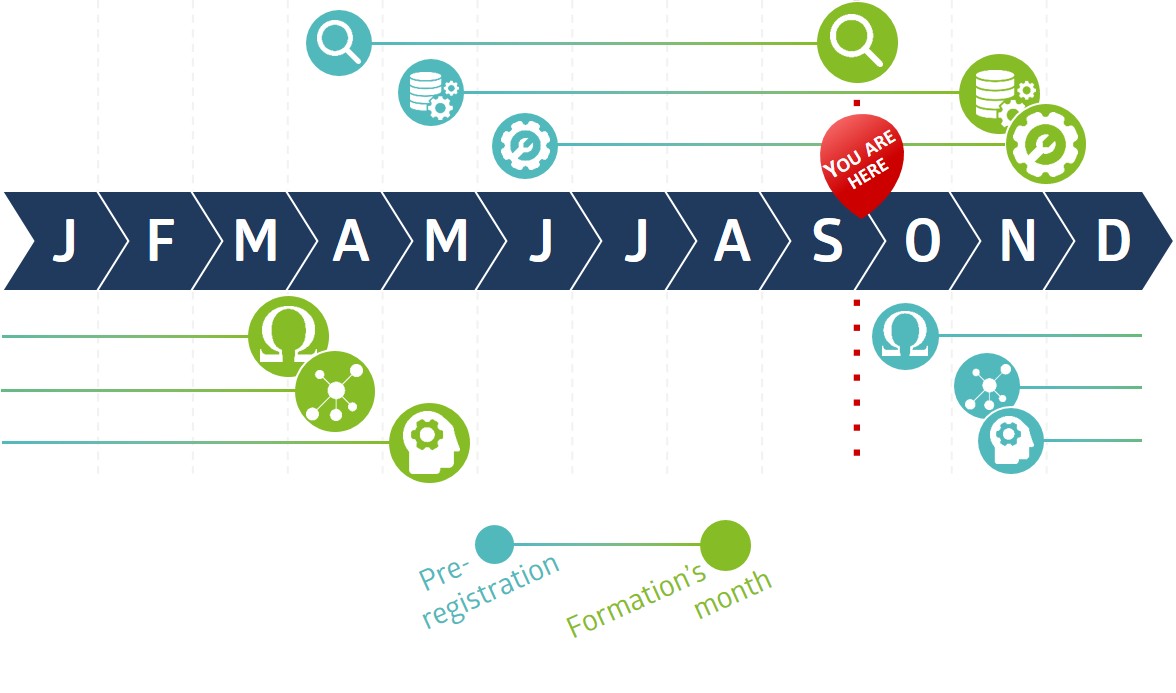

Pre-registration opens on 12 October 2026 – training course in March 2027: Theory-driven analysis of ecological data / 6th edition

- In English
- Training in mathematical modelling techniques (differential equations, Lotka–Volterra models, Jacobian matrices, etc.), as well as in the statistical interface between models and biodiversity data.
- Organised in partnership with the TheoMoDive Research Group (GDR), with financial support from the Maths-Vives Priority Research Programme and Equipment (PEPR).
Pre-register for the 2027 Theoretical Analysis training course
Pre-registration opens on 2 November 2026 – training course in April 2027: Analyzing ecological network data / 4th edition

- In English
- Training in ecological network data analysis, covering a general introduction to networks, standard metrics (including modularity, nestedness and clustering), null models, generative models (SBMs), multilayer networks, and an overview of newer techniques such as embedding. The course combines traditional lectures with practical case studies.
- With financial support from ANR EcoNet and the Maths-Vives Priority Research Programme and Equipment (PEPR).
Pre-registration opens on 7 December 2026 – training course in June 2027: AI for ecologists: a toolkit / 3rd edition

- In English
- Introduces artificial intelligence concepts and tools through a combination of theory and practical exercises. Using different types of data commonly encountered in ecology, the course aims to equip participants with the skills and confidence to identify which algorithms are best suited to their research questions, where to find them, and how to adapt them to the problem at hand.
See the full list of training courses
Team updates
The first half of 2026 saw three postdoctoral researchers leave CESAB:
- Cassie Speakman, from the DISCAR project,
- Miriam Beck, from the IMPACTS project,
- and Chloé Vagnon, from the FOOD-WEBS project.
We wish them all the very best and hope to see them back at CESAB soon!
More recently, we have had the pleasure of welcoming two new postdoctoral researchers:
- Matthew Faith, based at our Montpellier office and working on the FISHMIP-OSP project,
- Katherine Hébert, spending her first year at our Paris headquarters and working on the KNOWLEDGE HUB PROTECTED AREAS project.
Welcome to you both!
Chloé Vagnon's portrait
After two years of research on freshwater food webs as part of the FOOD-WEBS group, Chloé’s postdoctoral contract is coming to an end. This is an opportunity to discuss her research, how collaboration took shape within this international consortium, and what advice she would give to future postdoctoral researchers joining synthesis groups at CESAB. Enjoy reading!
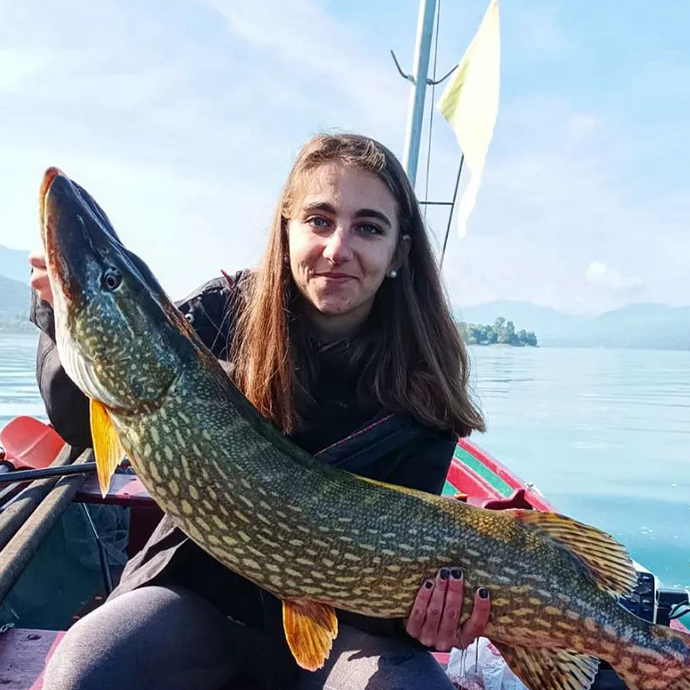
- Hello Chloé, could you briefly introduce your research, both before and during the FOOD-WEBS project?
I am an ecologist specialising in freshwater ecosystems, with a particular soft spot for fish. I seek to understand how these ecosystems function and respond to disturbances, so that we can better anticipate how they will change in response to global change and protect them more effectively. To do this, I combine empirical approaches based on field data, collected through scientific fishing surveys, sampling and automated sensors measuring water characteristics, with modelling approaches to better understand interactions between species and their environment.
More specifically, the FOOD-WEBS project focused on interactions between species, reconstructed using analyses of the chemical elements found in organisms’ tissues (stable isotopes), based on data collected around the world.
- One of the distinctive features of postdoctoral positions at CESAB is that they are embedded in international data-synthesis projects, with a strong emphasis on scientific coordination within the consortia. Looking back on the main stages of your experience, which moments, challenges or experiences stand out most? And what advice would you give to new postdoctoral researchers?
My first workshop with FOOD-WEBS was a special experience for me: it was the first time I had met many of the researchers whose work I had cited throughout my previous research contracts. Finding my place in a group that impressed me so much took a little time, but their kindness and support soon helped me thrive, both professionally and personally. One thing that made a real difference was how tasks were allocated: the project leaders made sure that the project’s coordination did not rest solely on my shoulders. This allowed me to focus on my research, which benefited the whole group. I think that is the main message I would share with future postdoctoral researchers!
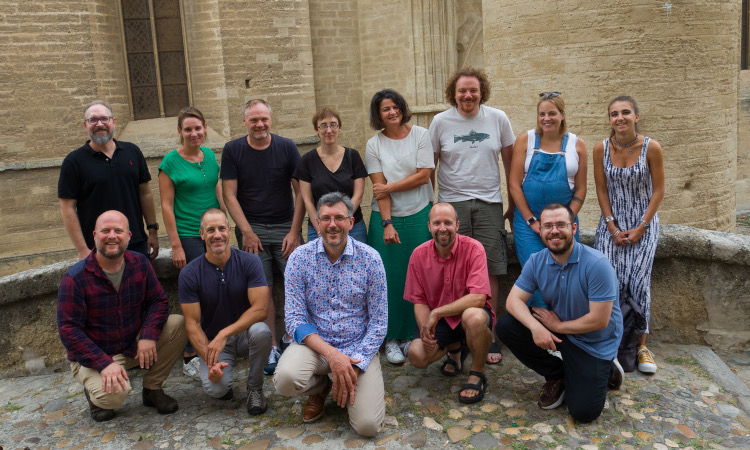
The FOOD-WEBS group during its first workshop at CESAB in September 2023
Beyond the strictly scientific aspects, organising the workshops was just as rewarding, whether at CESAB in Montpellier or, in our case, in Scotland! Thanks to the dedication and professionalism of our wonderful support team at CESAB, our working weeks always took place under the best possible conditions. Being so well supported and welcomed is a real privilege in a research project. It allowed us to devote all our time and energy to the work of FOOD-WEBS.
Beyond the workshops and research projects, we also work collaboratively with the scientific team based at CESAB (postdoctoral researchers from other projects, data scientists, and others). These group projects give us opportunities to get together and share our skills and knowledge while working towards a common goal. We are currently trying to bring together all the datasets generated by CESAB research groups to investigate questions relating to biodiversity loss and its role at the European scale. We’ll share more about this soon!
- How would you sum up this experience?
I’m coming away from this experience with a whole new set of skills, from managing global databases and international projects to coordinating scientific activities. Working within a consortium of around fifteen scientists has also given me the opportunity to build a wonderful international network—not just of professional contacts, but above all of genuinely kind people, all of whom have been welcoming and ready to help me wherever I am in the world. Thank you to FRB-CESAB and thank you to FOOD-WEBS! And a special mention to everyone who brightens our days in Montpellier: through seminars, lab meetings, geek meetings, as well as lunches, afternoon snacks and so much more. I’m looking forward to the day when I can return to the centre as a researcher rather than a postdoc!
It's published!
Since the last Newsletter: Articles highlighted on the FRB website and social media
Your articles are featured here too!
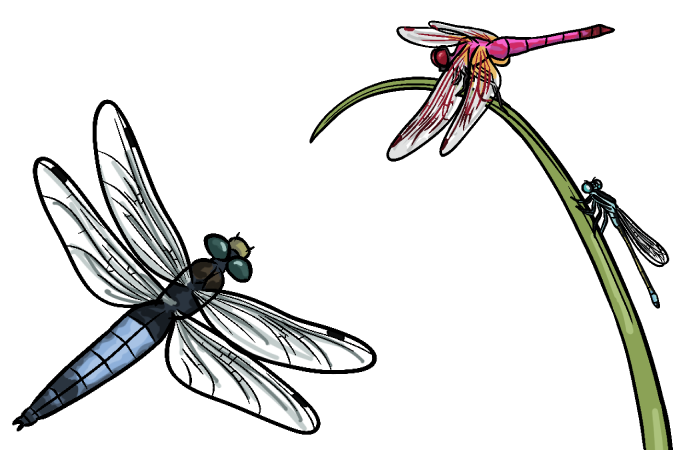
- Investing wetlands: what dragonflies tell us | While the main European biodiversity indicators still rely heavily on birds and butterflies, monitoring wetland habitats—which are essential ecosystems—remains less developed and receives less attention. Often elusive and short-lived, dragonflies could become key indicators of human impacts on these transitional ecosystems. This is precisely the goal of the scientists involved in the DRAGON project!
- The hidden power of citations: reflections on scientific citation practices | By citing some articles rather than others, researchers often unknowingly contribute to reinforcing the dominance of for-profit publishers. A study by the FRB’s CESAB team encourages researchers to examine and question their citation practices and introduces a new tool for scientists, fairpub, which can reveal hidden biases in bibliographies.

-
Beyond economic factors: the role of social behaviour in the establishment of protected areas | What explains the differences between countries in the proportion of land they designate as protected areas? Economic and institutional factors are obvious explanations, but certain social behaviours within populations may also play a role. This article highlights related research stemming from the SPATMAN group’s work.
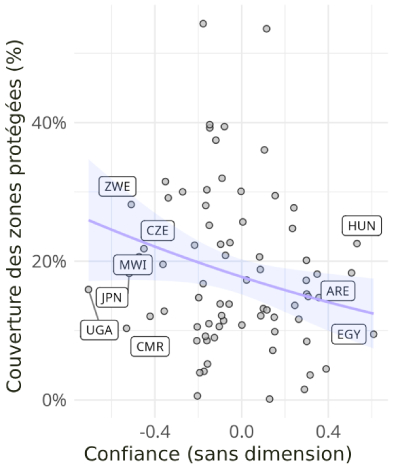
Negative relationship between trust in others and the proportion of land designated as protected areas. Each point represents a country.
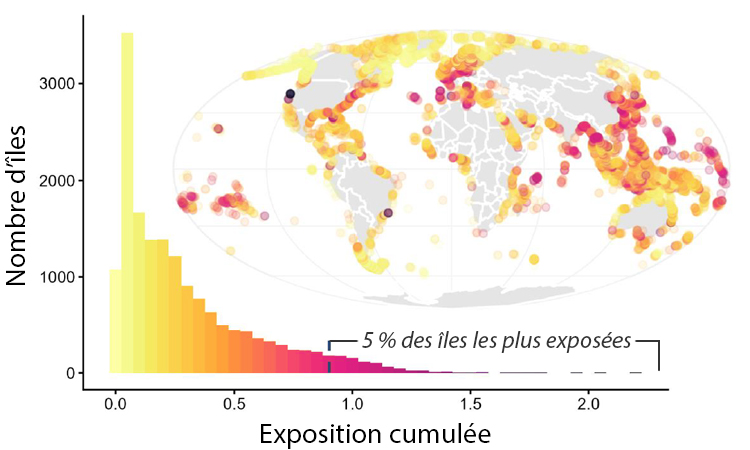
- First Global Map Reveals the Triple Challenge Facing Islands | The specific challenges faced by islands are brought into focus through the first global map showing their exposure to the triple threat of climate change, land-use change and biological invasions. Developed by the RIVAGE group, the map highlights the diversity of local contexts: there is no one-size-fits-all solution to biodiversity conservation, but rather a range of local strategies that must be adapted to each situation.
- Storms and lakes: when algae turn back | Storms, which are becoming more frequent due to climate change, can disrupt the delicate balance of lakes, even causing their phytoplankton communities to revert to an earlier state—a phenomenon known as “reversal”. This article draws on the research conducted by the GEISHA group.
The scientific publications
[ACOUCENE]
- Bacquelé Q, Barnagaud J-Y, Violle C, Theunissen F & Mathevon N (2026) The global biogeography of passerine songs. Science, 393, 381-386. DOI: 10.1126/science.aee6239. Busana M, Sèbe F, Barbaro L, Carruthers‐Jones J, Croci S, Eldridge A, Farina A, Gasc A, Gemard C, Haupert S, Müller S & Barnagaud J (2026) Spatial distribution of acoustic traits in bird assemblages along regional bioclimatic gradients. Ecography, 2026, e08011. DOI: 10.1002/ecog.08011.
[ACTIAS]
- Colwell RK, Guzman LM, Steinke D, Chao A, Janzen DH, Hallwachs W, Baker A, Fernández-Triana JL, Hebert PDN, Joyce F, Puschendorf R, Quicke DLJ, Rougerie R, Smith MA, Zamora N & Sharkey MJ (2026) Constructing a lower-bound estimate of the global number of insect species on a hyperdiverse empirical foundation. Proceedings of the National Academy of Sciences, 123, e2524283123. DOI: 10.1073/pnas.2524283123.
- Mialhe F, Piron A, Le Floch A, Griffon S, Scholte P, Pradel R, Ze SO, Guerbois C, Pays O, Church JM, Fritz H & Renaud P (2026) Effectiveness of protected areas in limiting agricultural encroachment and conserving herbivores in West‐Central African savannahs. African Journal of Ecology, 64, e70162. DOI: 10.1111/aje.70162.
[BEYONDS]
- Rigal S, Lenormand M, Tardieu L, Alonso H, Auniņš A, Bakx TRM, Boom MP, Brambilla M, Brotons L, Chodkiewicz T, Fontaine B, Fric ZF, Gamero A, Herrando S, Kålås JA, Kamp J, Kurlavičius P, Kuussaari M, Lehikoinen A, Maes D, Mestdagh X, Musche M, Øien IJ, Pettersson LB, Reif J, Rüdisser J, Šašić M, Schmucki R, Settele J, Stefanescu C, Stokke BG, Strebel N, Titeux N, Trautmann S, Van Swaay C & Luque S (2026) Predicted decline in common bird and butterfly species even under conservation policy scenarios in Europe. Nature Ecology & Evolution. DOI: 10.1038/s41559-026-03139-6.
- Oliveira BF, Bertrand R, Comte L, Lenoir J, Grenouillet G, Lancaster LT, Murienne J, Diamond S, Scheffers BR, Bandara RMWJ, Lawlor JA, Moore NA, Wolfe BW, Villalobos F, Weiskopf SR, Thompson LM, Pinsky ML & Rolland J (2026) Genetic diversity impacts climate‐Induced species range shifts. Ecology Letters, 29, e70345. DOI: 10.1111/ele.70345. Oliveira BF, Bertrand R, Pinsky ML, Casajus N, Wolfe BW, Scheffers BR, Villalobos F, Grenouillet G, Pecl GT, Chen I-C, Baecher JA, Lawlor JA, Sunday J, Murienne J, Rolland J, Thompson LM, Lancaster LT, Rubenstein MA, Moore NA, Bandara RMWJ, Diamond SE, Weiskopf SR, Lenoir J & Comte L (2026) Species range shifts often speed ahead of their modeled climatic niches. Proceedings of the National Academy of Sciences, 123, e2515903123. DOI: 10.1073/pnas.2515903123.
- Gill DA, D’Agata S, Blythe JL, Claudet J, Ban NC, Annasawmy P, Bennett NJ, Di Franco A, Epstein G, Evans L, Franks P, Gurney GG, Jupiter SD, Lau J, Lazzari N, Mahajan SL, Mangubhai S, Naggea J, Turner RA & Zafra-Calvo N (2026) Investing smarter and deeper to advance equity in high-stakes coastal locations in the Global South. Communications Sustainability, 1, 54. DOI: 10.1038/s44458-026-00052-8.
[BRIDGE]
- Fried G, Rievrs‐Borges E, Juárez‐Escario A, Maskell L, Bourgeois B, Carboni M, González‐Sargas E, Tabacchi A & Tabacchi E (2026) Hypervolume trait spaces reveal similarities but also functional differentiation across riparian, roadside and field margin habitats. Diversity and Distributions, 32, e70247. DOI: 10.1111/ddi.70247.
[DRAGON]
- De Knijf G, Bried J, Engel T, Jeanmougin M, Fontaine C, Schmucki R & Nicvert L (2026) OdonTraits Europe. A comprehensive traits dataset for European dragonflies and damselflies. Scientific Data, accepted. DOI: 10.1038/s41597-026-07667-5. Nicvert L, De Knijf G, Bowler DE, Bried JT, Coulon A, Engel T, Van Grunsven RH, Jeliazkov A, Lamouille-Hébert M, Jeanmougin M, Fontaine C & Schmucki R (2026) Linking species traits and vulnerability indicators in European Odonata. Biological Conservation, 317, 111786. DOI: 10.1016/j.biocon.2026.111786.
[FAIRWOOD]
- Marchand LJ, Prislan P, Gričar J, Nabais C, Larysch E, Silvestro R, Flores O, Rathgeber CBK & Fonti P (2026) Recommendations for assessing xylogenesis in angiosperm trees. Quantitative Plant Biology, 7, e4. DOI: 10.1017/qpb.2026.10039.
[FORCIS]
- Chaabane S, Schiebel R, Meilland J, Brummer G-JA, Mortyn PG, Sulpis O, Chalk TB, Giraud X, Howa H, Kuroyanagi A, Beaugrand G & De Garidel-Thoron T (2026) Reassessment of the global distribution and diversity of modern planktonic foraminifera from the FORCIS database. Journal of Micropalaeontology, 45, 195-217. DOI: 10.5194/jm-45-195-2026.
- Figary SE, Meyer MF, Pilla RM, Currie WJS, Alcocer J, Alfonso MB, Andrews CM, Anneville O, Antão‐Geraldes AM, Arnott SE, Ban S, Banerjee A, Bernát G, Beyer JE, Blank K, Bowen KL, Brönmark C, Bruel R, Burnet SH, Butts TJ, Carey CC, Caroni R, Chakrabarty M, Chandra S, Christoffersen KS, Cortés A, Crispim MC, De Eyto E, Cardoso LDS, Deemer BR, DeGasperi CL, DeMattei BC, Deng J, Descy J, Dimante‐Deimantovica I, Diovisalvi N, Dondajewska‐Pielka R, Doubek JP, Dražina T, Dugan HA, Dulić Z, Dunker AA, Dur G, Edwards BA, Ejsmont‐Karabin JE, Elmarsafy M, Ersoy Z, Fernandez R, Feuchtmayr H, Fontanarrosa MS, Forasacco E, G.‐Tóth L, Gaiser EE, Gal G, Galir A, Garcia De Souza JR, Girdner SF, Goldyn R, Hambright KD, Hamilton DP, Hansson L, Hendricks SP, Chen H, Isumbisho PM, Jacquet S, Yang J, Kainz MJ, Karpowicz M, Khan S, Kowalczewska‐Madura K, Kuczyńska‐Kippen N, Langenheder S, Lawhun SD, Leoni B, Lepori F, Lin S, Litt AH, Mackay EB, Manca MM, Matsuzaki SS, Matthews B, May L, McElarney YR, McLimans CJ, Menezes RF, Merz E, Michaloudi E, Moe SJ, Müller‐Navarra DC, Muñoz‐Colmenares ME, Nasworthy KC, Nava V, Nejstgaard JC, Obertegger U, Ortiz DA, Oseguera LA, Paterson MJ, Piccolo MC, Pinheiro‐Silva L, Piscia R, Pomati F, Rasconi S, Reid BL, Ribeiro LL, Rojas Molina FM, Rosińska J, Rudstam LG, Rusak JA, Rusanovskaya OO, Salmaso N, Sarvala J, Schladow SG, Schmidt AG, Scofield AE, Scordo F, Sed’a J, Senft KJ, Shchapov K, Shimaraeva SV, Silow EA, Špoljar M, Straile D, Sundberg SM, Sweetman JN, Symons CC, Tanentzap AJ, Tartarotti B, Thackeray SJ, Thrane J, Timofeyev MA, Tittel J, Urrutia‐Cordero P, Verburg P, Vieira DM, Wander HL, Watanabe S, Watkins JM, White DS, Wollrab S, Moreno VY, Zagarese HE, Zagars M & Znachor P (2026) The Zooplankton International Geospatial dataset: A global repository of spatiotemporal freshwater zooplankton community composition data from lakes and reservoirs to support ecological research. Limnology and Oceanography Letters, 11, e70152. DOI: 10.1002/lol2.70152.
[IMPACTS]
- Goury R, Bowler DE, Harrower C, Münkemüller T, Vallet J, Yearsley JM, Thuiller W & Pescott OL (2026) A practical guide to species trend detection with unstructured data using local frequency scaling (Frescalo). Ecography, 2026, e08270. DOI: 10.1002/ecog.08270.
- Thomas A, Thuiller W & Gonzalez A (2026) Complementary causal approaches to support biodiversity change attribution. Nature Reviews Biodiversity, 2, 322-334. DOI: 10.1038/s44358-026-00146-0.
- Tzivanopoulos M, Gallien L, Münkemüller T, Hedde M, Michez D, De Manincor N, Fontaine C, Gérard S, Sentil A & Thuiller W (2026) Continental‐scale invertebrate distributions are mainly associated with climate but modulated by soil and land‐use gradients. Global Ecology and Biogeography, 35, e70282. DOI: 10.1111/geb.70282.
- Gérard S, Marsden C, Belaud E, Biryol C, Capowiez Y, Estopinan J, Ferchaud F, Forest M, Ngao J, Goury R, Masson A-S, Orrière S & Hedde M (2026) Evaluating the delayed, causal effects of summer irrigation on winter earthworm communities in a Mediterranean agroforestry trial. Agriculture, Ecosystems & Environment, 408, 110455. DOI: 10.1016/j.agee.2026.110455.
- Sara S-M, Wilfried T, Esther G, Thibaud D, Sylvain G, Daniel F. M, Claire M, Yvan C & Mickaël H (2026) Digging deeper: Deep joint species distribution modeling reveals environmental drivers of earthworm communities. Soil Biology and Biochemistry, 212, 110021. DOI: 10.1016/j.soilbio.2025.110021.
[NAVIDIV]
- Sexton AN, Staentzel C, Jeliazkov A, Casajus N, Buijse T, De Leaniz CG, Jähnig S, Martínez‐Fernández V, Schmidt‐Kloiber A, Tales E, Wantzen KM, Wolter C & Beisel J (2026) Freshwater navigation is linked to non‐native species distributions across spatial scales. Diversity and Distributions, 32, e70204. DOI: 10.1111/ddi.70204.
[RIVAGE]
- Marino C, Benítez‐López A, Butt N, Caetano G, Capdevila P, Denelle P, Etard A, Fernández Palacios JM, Ferreiro‐Arias I, Leclerc C, Lenoir J, Philippe‐Lesaffre M, Rigal F & Bellard C (2026) Contrasting vulnerability profiles for insular assemblages of birds and mammals facing global change. Conservation Biology, accepted. DOI: 10.1111/cobi.70261.
- Adjeroud M, Carlot J, Brandl S, Bigot L, Guilhaumon F, Job S, Kayal M, Maréchal J-P, Monnier O, Pellerin F, Penin L, Wickel J, Wicquart J & Parravicini V (2026) Coral reef monitoring in French overseas territories: Status, knowledge gaps, and improvements to meet national and European environmental policy objectives. Environmental and Sustainability Indicators, 30, 101255. DOI: 10.1016/j.indic.2026.101255.
[Membres Cesab]
- Beck M, Annasawmy P, Birre D, Busana M, Casajus N, Coux C, Marino C, Mouquet N, Nicvert L, Oliveira BF, Petit-Cailleux C, Tortosa A, Unkule M, Vagnon C & Veytia D (2026) Citation self-awareness for a fairer academic publishing landscape. BioScience, accepted. DOI: 10.1093/biosci/biag028.
- Mouquet N, Blanc N, Brassac T, Casajus N & Tribot A-S (2026) Too cute to be wild: What teddy bears reveal about our disconnection from nature. BioScience, 76, 203–206. DOI: 10.1093/biosci/biaf146.
- Petit-Cailleux C, Journé V & Dagorn E (2026) Human population behavioural traits matter for explaining terrestrial protected area coverage. Biological Conservation, 321, 111971. DOI: 10.1016/j.biocon.2026.111971.
To receive the CESAB newsletters directly, suscribe!
ouvrir/fermer
Previous newsletters
Translation
This translation was done automatically from French and may contain some phrasing errors.