Home >
Publications >
The Hidden Power of Citations – Reflections on scientific citation practices
Biodiversité ! Le Média
Article, Opinion
Publié : 30 April 2026
The Hidden Power of Citations – Reflections on scientific citation practices
Authors: Violette Silve & Miriam Beck
Proofreaders: Nicolas Casajus, Pauline Coulomb, Hélène Soubelet
Lecture : 7 min
Buying free-range eggs, choosing fair trade products, or reducing plastic consumption are all individual actions that, when combined, can transform supply. Ethical consumption, now a common practice among consumers, could it also apply to science? In the academic world, the number of citations is often interpreted as an indicator of an article’s impact and relevance. By citing certain papers rather than others, researchers contribute—often unknowingly—to reinforcing the dominance of for-profit publishers. A recent study by postdoctoral researchers and data scientists from the synthesis center (Cesab) of the FRB invites us to explore and question citation practices, and introduces a new tool for scientists, fairpub, capable of revealing hidden biases in bibliographies.
"Standing on the shoulders of giants"
This famous metaphor, attributed to Bernard of Chartres in the 7th century, vividly illustrates how science works. Each advance, each step further, is only possible thanks to the height provided by an already constructed body of knowledge. To add their own contribution to this structure and ensure its solidity, scientists must be able to support each of their claims with one or more references, carefully chosen to substantiate their point.

“La cigale ayant chanté tout l’été (Williams & Simons, 1995), se trouva fort dépourvue quand la bise fut venue (Hoppendsteadt and Keller, 1976).” could have been written by a Dr. La Fontaine working on hemipterans (for our fellow english readers: this is a famous french poem, which can be translated as “The cicada, having sung all summer, found itself quite destitute when the north wind came“).
Scientific writing is shaped by these citation choices. In theory, these choices are straightforward: the scientist selects the most relevant source to support their argument. In practice, however, other factors sometimes come into play—often unconsciously—such as an article’s visibility, the reputation of the journal in which it is published, or its impact factor.
Publishing in Research
Scientific articles are published in peer-reviewed journals, now primarily online, and managed by publishers. They can be broadly classified into three categories based on their economic model: for-profit journals, non-profit journals, and “academic-friendly” journals that reinvest their revenues into research (for example by funding and/or organizing conferences).
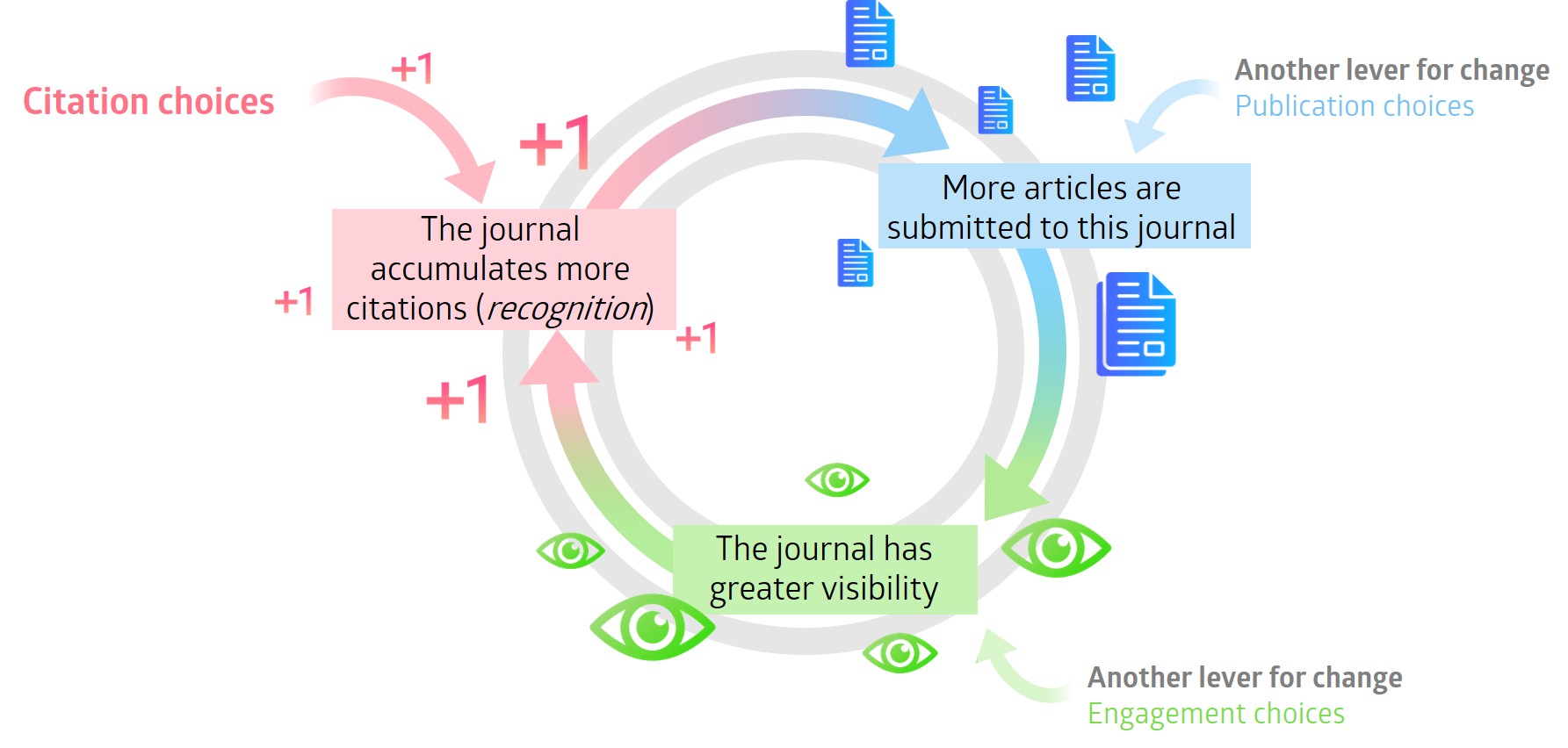
Today, an increasing share of publications is controlled by large commercial publishers. Over just a few decades, their influence has grown considerably: the share of articles published by these journals has risen from around 20% in the 1970s to more than 50% in 2013. The more visible a journal is, the more submissions it attracts; the more articles it publishes, the more it is cited. This feedback loop helps consolidate the dominance of the most prestigious journals, often for-profit.
In response to this observation, postdoctoral researchers and data scientists at Cesab propose the idea of a “virtuous circle.” Without ever compromising scientific rigor, the aim would be to cite more articles—whenever possible—from “academic-friendly” journals, in order to increase their visibility.
Here we find the familiar logic mentioned earlier: that of the consumer choosing free-range eggs. After ethical consumption, why not consider a form of ethical citation?
Towards Ethical Citation – A Tool for Scientists
This good intention raises a practical challenge: who has the time to examine the editorial policies of every journal listed in a bibliography? Very few people—and the authors of the study are well aware of this. That is why they created: fairpub.
This tool allows researchers to automatically analyze a list of references and assess their distribution according to the economic model of the journals. It thus makes potential biases in citation practices visible.
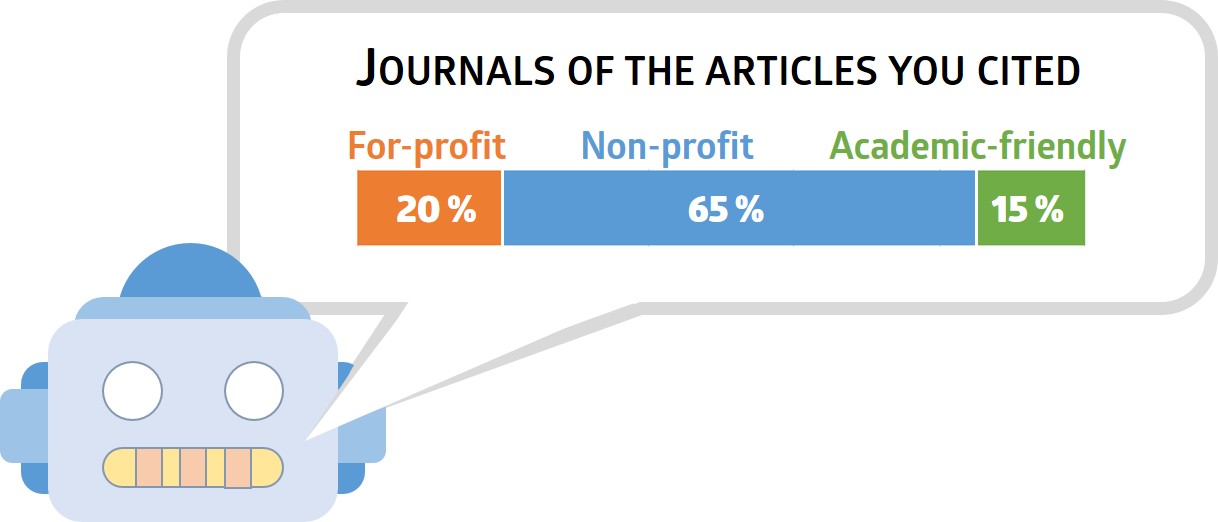
*Non-contractual illustration
The tool notably relies on the Dafnee database, which classifies journals according to their operating model and reinvestment policies—an initiative of the Isem (Institute of Evolutionary Sciences of Montpellier). For now limited to certain fields such as ecology and evolution, this initiative could eventually be extended to other disciplines.
CONTEXT
This proposal is part of a broader reflection led by early-career researchers at Cesab, who highlight the difficulty of reconciling career advancement with ethical commitments.
In order to make their profiles more competitive, they face strong pressure to publish in high-impact journals, often owned by large commercial groups.
In a first opinion paper published in 2024, postdoctoral researchers from the Cesab of the FRB called for changes in practices, pointing to concrete levers at different stages of academic life. This second article goes a step further by exploring one of these levers: citation practices.

Reference
Beck, M., Annasawmy, P., Birre, D., Busana, M., Casajus, N., Coux, C., Marino, C., Mouquet, N., Nicvert, L., Oliveira, B. F., Petit-Cailleux, C., Tortosa, A., Unkule, M., Vagnon, C., & Veytia, D. (2026). Citation self-awareness for a fairer academic publishing landscape. BioScience, biag028. https://doi.org/10.1093/biosci/biag028