The FRB in action
The Scenario #2 program
Living ‘well’ in 2050 or beyond, within one’s own region: What socio-ecosystems and what role for biodiversity?
For more than 10 years, the issue of scenarios has held a special place at the FRB. In recent years, stakeholders have expressed new needs to anticipate the risks they will face, such as losses in agricultural yields due to the erosion of soil biodiversity in the coming years, as well as opportunities linked to the preservation of biodiversity, such as the benefits of protected areas in terms of human health. What strengths should we draw upon to successfully shift trajectories towards a desirable future? How do these relate to their diverse values and worldviews? It is against this backdrop that the FRB’s second Scenario programme was launched in 2022.
The Scenario #2 programme utilises scenarios as tools for exploring possible and plausible futures. As vehicles for raising awareness and building knowledge on complex issues, such as the future of biodiversity and societies, they are invaluable for developing capacities for anticipation, decision-making and collective organisation. With a resolutely transdisciplinary approach, the FRB supports research projects that anchor scenario-building within local communities and draw on the knowledge and expertise of a wide range of stakeholders. This programme is based on three pillars – narratives and artistic approaches, mental mapping and modelling – and delivers initiatives in scientific outreach and support.
Scenarios: an opportunity to foster a meaningful dialogue between science and society
Whilst not predictions, scenarios enable us to reflect on past and future events. Whether exploratory or targeted, to use the IPBES terminology, they seek to anticipate both the effects of biodiversity loss and the effectiveness of solutions based on ecosystems, governance, planning, technology and so on. These tools are also powerful means of raising awareness, imparting knowledge and fostering a sense of responsibility on issues that can be difficult to grasp. They are invaluable for developing the capacity for foresight, decision-making and collective organisation.
One ambition, three pillars
How can we live well in 2050 or beyond, within our own regions, and what role will biodiversity play, and what kinds of socio-ecosystems will shape this future? This is the central question addressed by this programme, which uses scenarios both as tools for identifying the levers to be activated in order to bring about the transformative changes our societies need, and as vehicles for raising awareness and transferring knowledge with and for stakeholders. It thus helps to tackle the challenges of protecting and sustainably using biodiversity through three pillars:
- Narratives, artistic approaches and the sensory, to capture and foster the integration of the imagination in order to construct visions of transition;
- Mental mapping to capture and represent diverse visions and collective structures, and to elucidate the territorial dynamics at work within complex socio-ecosystems;
- Modelling to structure and formalise – based on existing data and under various hypotheses – the properties of socio-ecosystems, human decisions and the responses of biological diversity, ecosystems and ecosystem services to these decisions.
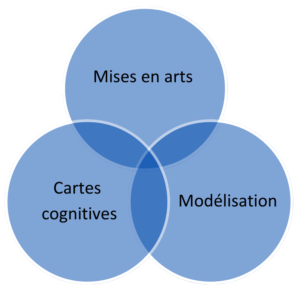
The Scenario #2 programme aims to address the intersections within this framework and, ideally, the aspects common to all three pillars.
Transdisciplinary projects rooted in local communities
The Scenario #2 programme supports projects through calls for proposals. These projects aim to develop contrasting regional scenarios for ecological and social transition – roadmaps for transformative change in the study areas by 2050 or beyond. Biodiversity issues lie at the heart of these scenarios. A distinctive feature of the programme is that the projects adopt a strongly transdisciplinary approach by involving local stakeholders. These projects are structured around three interrelated scientific and methodological pillars, which, as a reminder, are artistic narratives and approaches, mental mapping and modelling.
A national science outreach programme
At the same time, the Scenario #2 programme contributes to the discussion on scenarios and offers scientific facilitation for interested research communities. Meetings facilitate connections, the emergence of collaborative networks and the identification of research questions of interest. Workshops provide an opportunity to share experiences, methods and cutting-edge scientific developments. The Scenario #2 programme also develops methodological support in line with the programme’s three pillars.
The workshops:
- June 2023 | National workshop: Territorial scenarios and transition pathways: what kind of transdisciplinary research?
- February 2024 | National workshop: Territorial scenarios and transition pathways: laying the groundwork!
- May 2026 | National workshop: Territorial scenarios and transition pathways: updates from the regions
The workshops:


The call for proposals:
Resources
- Bonnes pratiques et recommandations pour l’utilisation de cartes cognitives floues (FCM) dans la conservation de la biodiversité pour produire des scénarios ;
- journée scientifique nationale 2026 du Programme Scénario #2|Scénarios territoriaux et trajectoires de transitions : des nouvelles des territoires – Actes ;
- journée scientifique nationale 2025 du Programme Scénario #2|Scénarios territoriaux et trajectoires de transitions : préparer le terrain - Actes ;
Governance
Two committees are involved in the programme’s governance to ensure that it remains relevant both scientifically and to society
ouvrir/fermer
The Steering Committee
ouvrir/fermer
The Scientific Committee
The programme’s pilots
ouvrir/fermer
Stories and artistic approaches
ouvrir/fermer
Mind maps
ouvrir/fermer
Modelling
Programme details
Translation
This page is an automatic translation of the French version. There may still be errors or inaccuracies in the translated text.
On the same topic