The FRB in action
Project ongoing since 2023
FOOD-WEBS
Food-webs in the Anthropocene : a stable isotope synthesis to understand the global response of freshwater ecosystems
Global environmental change is fundamentally reshaping biological diversity, impacting the functioning of ecosystems and disrupting key ecosystem services provided to humans. Food-web ecology provides a unique opportunity to better understand the effects of global change on ecosystems. To this day, studies comparing foodwebs at large spatial and temporal scales are limited by the fact they rely on estimates of trophic links arising from models.
The project will study foodwebs by bringing together numerous data from isotope analyses at the global scale. This approach will shed light on how biodiversity and ecosystems respond to global changes. Isotope data will be used to i) investigate the patterns and drivers of food-web structures at broader spatial scales, ii) determine the importance of intraspecific variability in food-webs and iii) understand how energy transfer efficiency is affected by global changes.
To this end, several aspects of biodiversity will be studied (taxonomic, functional and phylogenetic) to develop metrics assessing ecosystem health that will be based on isotope properties in the food-webs.
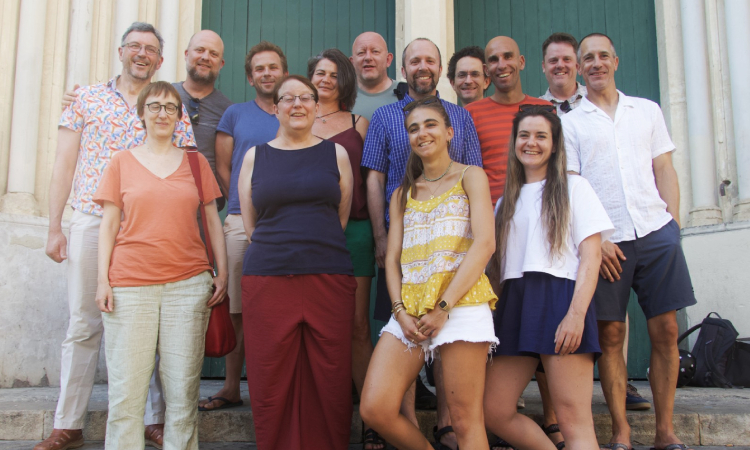
The Food-Webs group during their last workshop at the CESAB in July 2026.
RESEARCHERS
Principal Investigators (PIs):
Julien CUCHEROUSSET – CNRS (France);
Michelle JACKSON – Oxford University (UK);
Julian D. OLDEN – Washington University (USA)
ouvrir/fermer
Participants:
FOODWEBS brings together specialists in aquatic ecology, ecology of stable isotopes, theory of interaction networks, biogeography, evolutionary biology, ecotoxicology and conservation biology.
PROJECT
FOODWEBS was selected from the 2022 call for proposals. The project selection process was carried out by a committee of independent experts.
Publications
[03] Boulêtreau S, Vagnon C, Comte L, Sagouis A, Pool T, Stiling RR, Harrod C, South J, McIntosh AR, Perga M-E, Sánchez-Hernández J, Roussel J-M, Tunney TD, Jackson M, Olden JD & Cucherousset J (2025) IsoFresh: A global stable isotope database of freshwater food webs. Knowledge & Management of Aquatic Ecosystems, 15. DOI: 10.1051/kmae/2025010.
[02] Olden JD, Keppeler FW, Jardine TD, Boulêtreau S, Harrod C, Jackson MC, McIntosh AR, Perga M, South J, Tedesco P, Vagnon C & Cucherousset J (2025) Looks can be deceiving: Morphological traits are weakly associated with the isotopic niches of freshwater fishes. Global Ecology and Biogeography, 34, e70124. DOI: 10.1111/geb.70124.
[01] Perga M, Bouletreau S, Cucherousset J, Harrod C, McIntosh A, Olden JD, Vagnon C & Jardine T (2025) A global estimator of C and N isotope baselines for fresh waters. Methods in Ecology and Evolution, accepted. DOI: 10.1111/2041-210x.70225.