Home >
Publications >
Nature conservation: greater inclusivity for greater effectiveness
Biodiversité ! Le Média
Synthesis
Publié : 11 March 2026
I Mis à jour : 13 March 2026
Nature conservation: greater inclusivity for greater effectiveness
Author: Violette Silve (FRB)
Review: Pauline Coulomb (FRB), Antoine Leblois (CEEM, Inrae), Lou Lecuyer (CNRS & FRB-CESAB)
How can the effectiveness and durability of conservation policies be improved? International research now points to a structuring answer: green and blue justice.
Four projects supported by the FRB and hosted within its Centre for the Synthesis and Analysis of Biodiversity (CESAB) explored this concept in greater depth and presented it during a conference organized in December in Paris. Their findings converge: social justice and equity are not merely moral imperatives, but essential conditions for ecological success. They determine local acceptance, effectiveness, and the long-term impact of projects.
Beyond this observation, scientists propose concrete tools to assess how social justice is integrated into projects, as well as guidelines for putting it into practice. The challenge now is to take them up.
Nature to protect — and that gives back in return
Based on a study from a collaboration between the FRB-Cesab Parsec group and the MPA-Poverty group, funded by the ANR: Desbureaux et al. 2024
Conservation and the economy are often seen as being in opposition, yet this is far from always the case. On the Tanzanian coast, for example, villages located near marine protected areas (MPAs) saw their standard of living increase by 50% over twenty years. MPAs can generate real socio-economic benefits.
This improvement may partly be explained by income diversification: development of tourism, service activities, and indirect jobs linked to the attractiveness of preserved marine environments. The authors observe a sectoral shift in activities, moving from the primary sector (agriculture and fisheries) to the secondary sector (industry, processing) and the tertiary sector (services, tourism, trade).
However, these results remain fragile: if marine ecosystems continue to degrade, some of these new income sources — particularly tourism — could also collapse. To avoid this scenario, scientists stress the need to bridge the gap between the stated protection objectives and what is actually implemented on the ground.
Learn more
Content related to the same study
Measuring equity to ensure no one is left behind
Based on a study from the FRB-Cesab Blue Justice group: Blythe et al. 2026
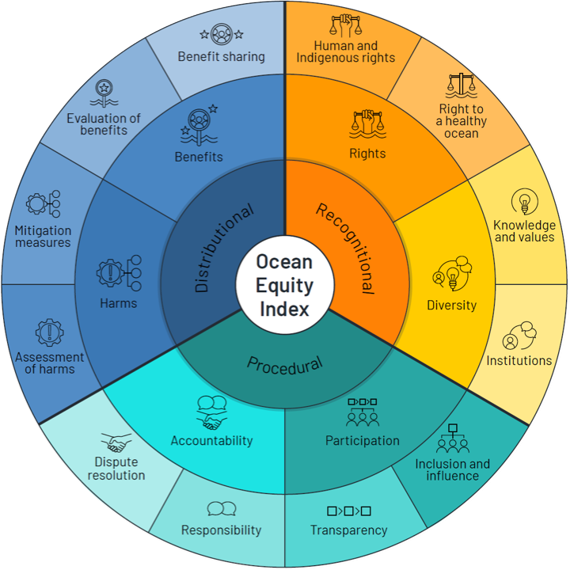
In the case of the marine protected areas in Tanzania mentioned above, marine conservation can benefit local populations. But how can this be ensured in other initiatives? Are the benefits truly equitable and sustainable? What place does each stakeholder have in project governance? To answer these questions, there is now a new tool: the Ocean Equity Index (OEI) published in Nature in January 2026, designed to concretely assess the fairness of marine policies and projects.
This index evaluates twelve criteria, such as respect for human rights, transparency in decision-making, and the equitable sharing of benefits. In practice, the tool offers decision-makers a real compass to identify precisely the weak points of a project — for example a lack of transparency, the absence of translation of documents into local languages, or the exclusion of certain groups — and to act to correct these inequalities before they undermine the success of conservation policies.
Learn more
- Read the press release: FRB website | CNRS website
- Access the OEI website
Nature is better protected when everyone is included
Based on studies from the FRB-Cesab JustConservation group: Dawson et al. 2024.a, Dawson et al. 2024.b.
Ensuring equity within a conservation project is far from anecdotal. When local communities play an influential role in its governance, the benefits are twofold: ecological dynamics improve and social outcomes improve as well.
This is revealed by a systematic review comparing more than 600 studies from conservation science around the world over more than 50 years. This extensive review shows that the most successful conservation projects on land and at sea are those where Indigenous peoples and local communities exercised primary control or engaged as equal partners in the projects.
However, this is not only about decentralization: for participation to work, it must rely on local strengths (cohesion, trust, shared knowledge, etc.) while also addressing power imbalances inherited from colonial history, extractive economic models, and certain development or conservation policies.

Figure. Scale of the six roles of Indigenous peoples and local communities in conservation (synthesis of 638 empirical studies) and ecological outcomes associated with each role (analysis of 170 studies of conservation initiatives).
Understanding power to transform participation
Based on a study from the FRB-Cesab PowerBiodiv group: Lécuyer et al. 2024
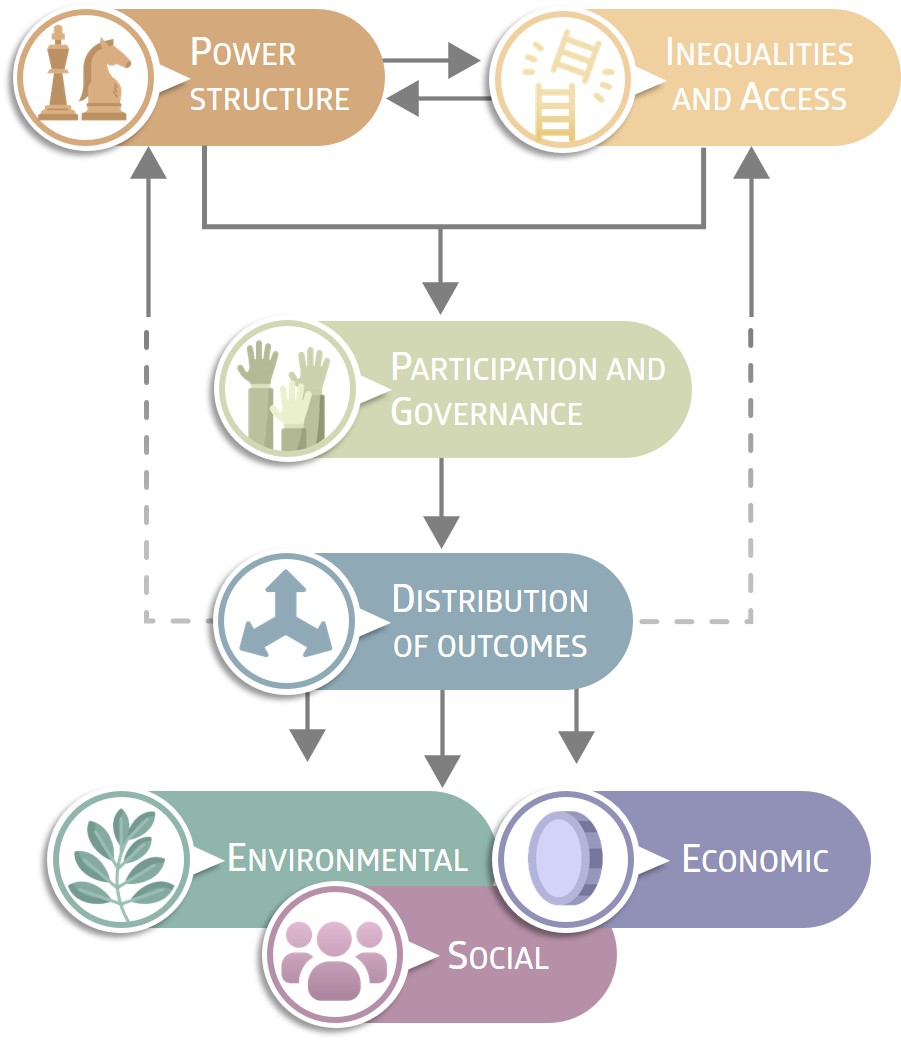
So how can these power dynamics be understood and transformed? First, it is important to keep in mind a key truth: bringing everyone together around the same table does not guarantee fair participation. Power often circulates invisibly, determining which voices are heard, which knowledge is recognized, and which decisions are actually made.
Participatory processes are not only technical — they are also deeply political and emotional. Silence, absence, or withdrawal of certain actors are themselves expressions of power.
By studying 42 case studies worldwide, researchers identified forms of power that can sometimes block a process and those that can help it move forward, such as delegating decision-making power upstream so that stakeholders can co-define the issues addressed and the format of the process, or recognizing the importance of a plurality of knowledge and perspectives.
In an interactive guide released only a few weeks ago, they provide clear language and practical reference points so that field teams can better understand these dynamics and build projects that are fairer, stronger and more effective for biodiversity.
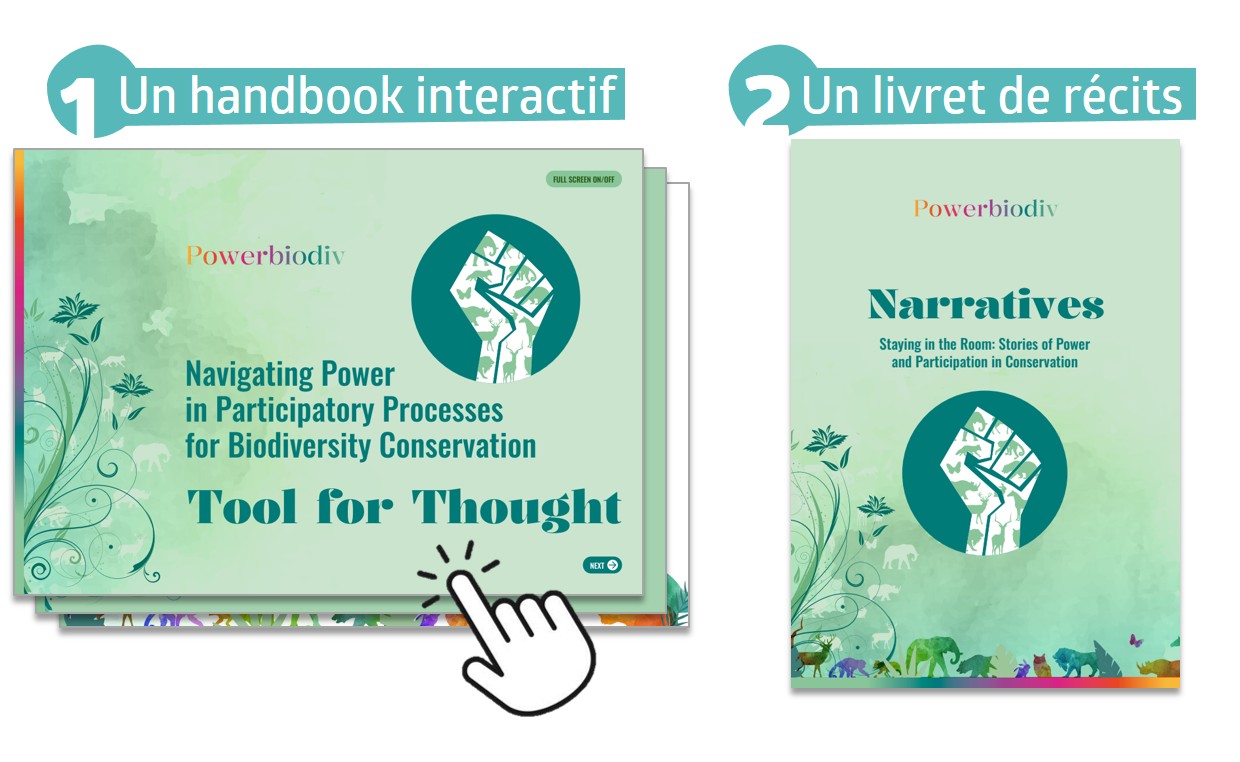
Access the interactive handbook Access the story booklet
Sources
- Blythe, J. L., Claudet, J., Gill, D., Ban, N. C., Epstein, G., Gurney, G. G., Jupiter, S. D., Mahajan, S. L., Mangubhai, S., Turner, R., Bennett, N. J., D’Agata, S., Franks, P., Lau, J., Ahmadia, G., Andrachuk, M., Annasawmy, P., Brun, V., Darling, E. S., Di Franco, A., Evans, L,. Lazzari N., Naggea, J., Relano, V., Pertuz, M. C., Villasante, S., Zafra-Calvo, N. (2026). The Ocean Equity Index. Nature, 650(8100), 123‑128. https://doi.org/10.1038/s41586-025-09976-y
- Dawson, N. M., Coolsaet, B., Bhardwaj, A., Brown, D., Lliso, B., Loos, J., Mannocci, L., Martin, A., Oliva, M., Pascual, U., Sherpa, P., & Worsdell, T. (2024). Reviewing the science on 50 years of conservation : Knowledge production biases and lessons for practice. Ambio. https://doi.org/10.1007/s13280-024-02049-w
-
Dawson, N. M., Coolsaet, B., Bhardwaj, A., Booker, F., Brown, D., Lliso, B., Loos, J., Martin, A., Oliva, M., Pascual, U., Sherpa, P., & Worsdell, T. (2024). Is it just conservation? A typology of Indigenous peoples’ and local communities’ roles in conserving biodiversity. One Earth, 7(6), 1007‑1021. https://doi.org/10.1016/j.oneear.2024.05.001
- Desbureaux, S., Girard, J., Dalongeville, A., Devillers, R., Mouillot, D., Jiddawi, N., Sanchez, L., Velez, L., Mathon, L., & Leblois, A. (2024). The long-term impacts of Marine Protected Areas on fish catch and socioeconomic development in Tanzania. Conservation Letters, 17(6), e13048. https://doi.org/10.1111/conl.13048
- Lécuyer, L., Balian, E., Butler, J. R. A., Barnaud, C., Calla, S., Locatelli, B., Newig, J., Pettit, J., Pound, D., Quétier, F., Salvatori, V., Von Korff, Y., & Young, J. C. (2024). The importance of understanding the multiple dimensions of power in stakeholder participation for effective biodiversity conservation. People and Nature. https://doi.org/10.1002/pan3.10672