Home >
Publications >
Breaking down individual stakes to enable change
Biodiversité ! Le Média
Interview
Publié : 16 September 2026
Breaking down individual stakes to enable change
Claude Garcia (BFH) & Violette Silve (FRB)
Lecture : 10 min
Claude Garcia is a professor at the Bern University of Applied Sciences (BFH) and a member of the FRB Scientific Council. As part of a series of portraits of the current members of the Foundation’s Scientific Council, Claude Garcia has chosen to tell us about his research on the place of humans, taking action, and… kiwis? Enjoy the read!
There is a growing body of scientific knowledge, expertise and experience. Do we have the tools we need to preserve biodiversity?
Knowing does not mean being able to act. Let me explain.
At first, I worked on tropical forests. I gradually saw trees disappear from my dataset, without understanding why. Since 20021, we have known that the disappearance of tropical forests is mainly driven by three factors: agricultural expansion, infrastructure development and timber extraction. These phenomena are themselves linked to underlying factors related to the economy, demographics, technologies, governance and culture.
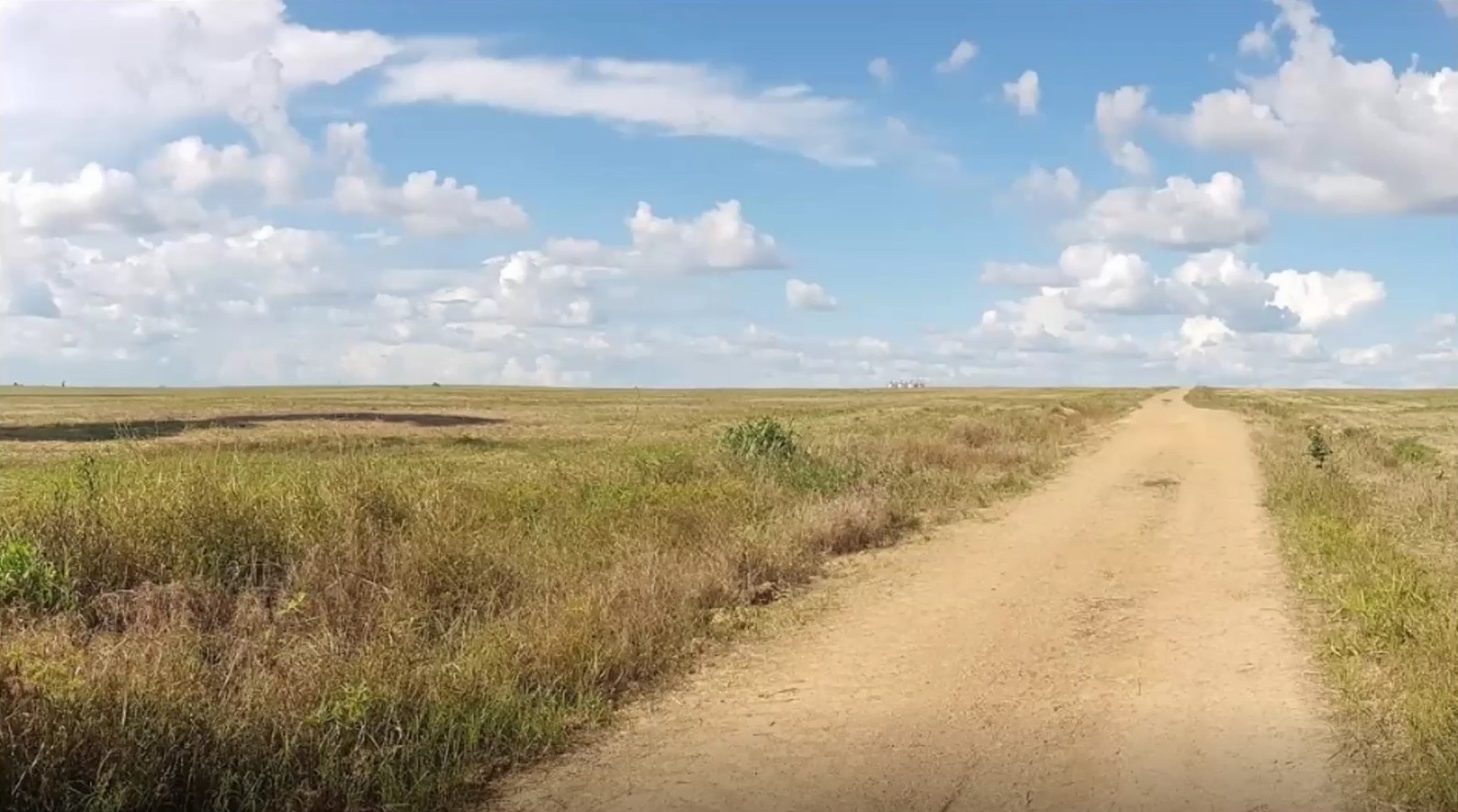
Photograph of “the Amazon that does not look like the Amazon” by Claude Garcia.
So, we have known the mechanisms of deforestation for more than twenty years, yet we are still unable to halt it. Looking at global targets and reports, the same observation could be made about climate or biodiversity: we are getting better and better at understanding what is happening, but this knowledge alone is not enough to halt or reverse the trend.
So why do you think we are failing? Is it a lack of political will?
Not only that. To return to tropical forests, look at how, since 2021, several newspapers have been reporting that the Amazon, the forests of Central Africa, or even the French forest, “now release more carbon than they store”.
These choices of words inadvertently conceal key actors: it is not the forest itself that has started releasing carbon, but people who, by exploiting the forest, are responsible for these emissions. This framing, which leaves human action out of the picture, is actually quite telling.
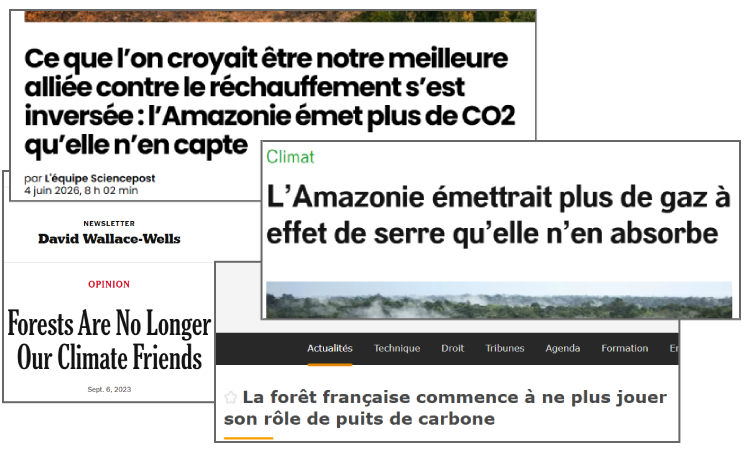
A selection of articles from SciencePost, Reporterre, the New York Times and Actu-Environnement.
We therefore need to go back to the source! I was surprised to discover that even Karl Marx had asked himself this question. In his “Critique of the Gotha Programme”2, he emphasized that there is no separation between nature and society: it is nature, not labour, that is the source of all wealth. Without nature, there is no economy. This was in 1875! So nature is the source, and that is our starting point. But today, the future of forests depends above all on the choices that women and men have made, are making, and will make in the years to come. This is, ultimately, what the Anthropocene is about. We therefore need to take a closer look at those who make these choices: we are all actors at different scales. This echoes the words of Richard Thaler, winner of the 2017 Nobel Prize in Economics: “To do good economics, you have to keep in mind that people are human.” The same applies to environmental policies: what is often missing from our policies and the models that underpin them are the humans and their interactions.
What if we tried to build a model that incorporates humans…
Let’s start with the most obvious element in a system: what we can see, namely the physical landscape (forests, mountains, rivers, roads). This system is inhabited, among others, by humans, who bring with them their social and political environment (norms, institutions, practices, social relations). These actors interact with one another, perceive their environment and act upon it. However, they do not all do so in the same way: their decisions depend on what they want, what they know, and what they think will happen or what others will do.
We thus obtain a representation of an ecological and social system, itself surrounded by other similar ecological and social systems, all interconnected (through exchanges of matter and information). External factors then affect the systems directly at different levels (global: climate change; regional: rainfall; local: fires or floods), or influence actors’ decisions (global: market fluctuations, technological innovations; regional: migration, political instability; local: needs and demands, governance).
So this is a first glimpse of what a model incorporating humans and their mental universe might look like!
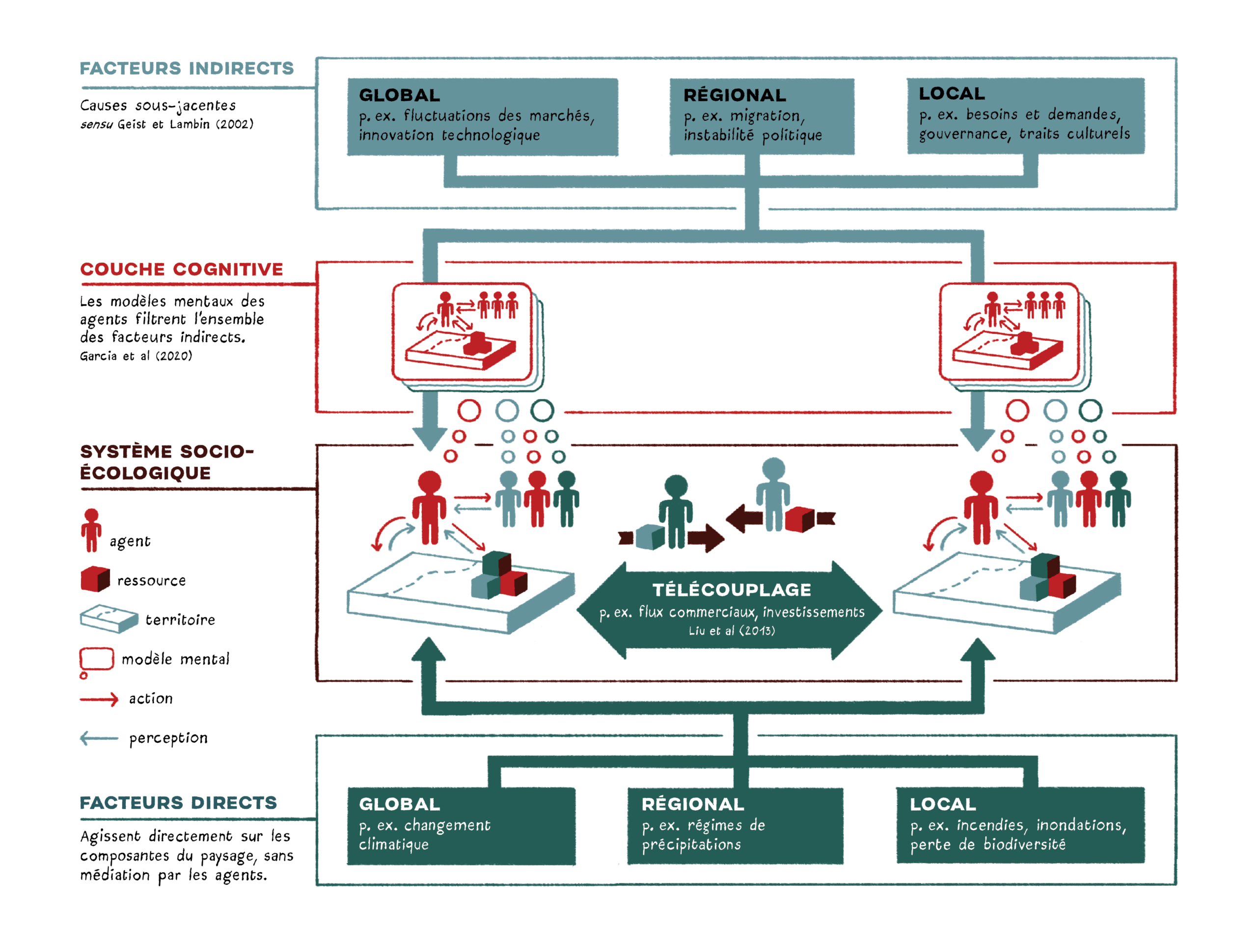
Representation of a complete social-ecological system, by Sylvain Mazas.
Why are interactions between humans so important?
Environmental problems are very often problems of strategic interactions, meaning that what one actor gains or loses depends largely on what others will do, not only on their own choices. This is true of almost all environmental policies. When a government wants to protect a species or limit the use of a substance, it depends on the decisions of those to whom the measure applies. One could say that “the forestry code protects the forest”. But it is not the code that protects the forest; it is the people who enforce it. Without them, the code is just a pile of paper good for propping up a table!
Let’s take a brief detour through game theory, the science of strategic interactions: it seeks to understand how the decisions of some depend on those of others. My work consists in making these concepts accessible and useful to decision-makers who have to act in specific territories, in situations marked by uncertainty and conflicting constraints.
More concretely, how can we represent and better take into account these personal interests?
We can map them! Let’s take the example of my early work on coffee plantations in India. Within these plantations, we can distinguish two groups of actors:
- the plantation owners, who own the plantations;
- and the workers who harvest the coffee on behalf of the owners.
Let’s assign them a “dependency” score ranging from 0 (not dependent at all) to 5 (highly dependent).
If we look at coffee production, the plantation owner is highly dependent on it: their standard of living, that of their family, and their retirement are linked to this production. We can therefore assign them a very high level of dependency. For the worker, the situation is different: their personal interest is more closely linked to their wages (regulated by law) than to production itself. Of course, if the plantation goes bankrupt, they will suffer the consequences, but the effect is indirect.
If we now look at firewood, the situation is reversed. For the worker, this resource is essential. For the plantation owner, who has access to gas and electricity, it is much less important.
Services provided within the same ecosystem therefore do not have the same value for everyone.
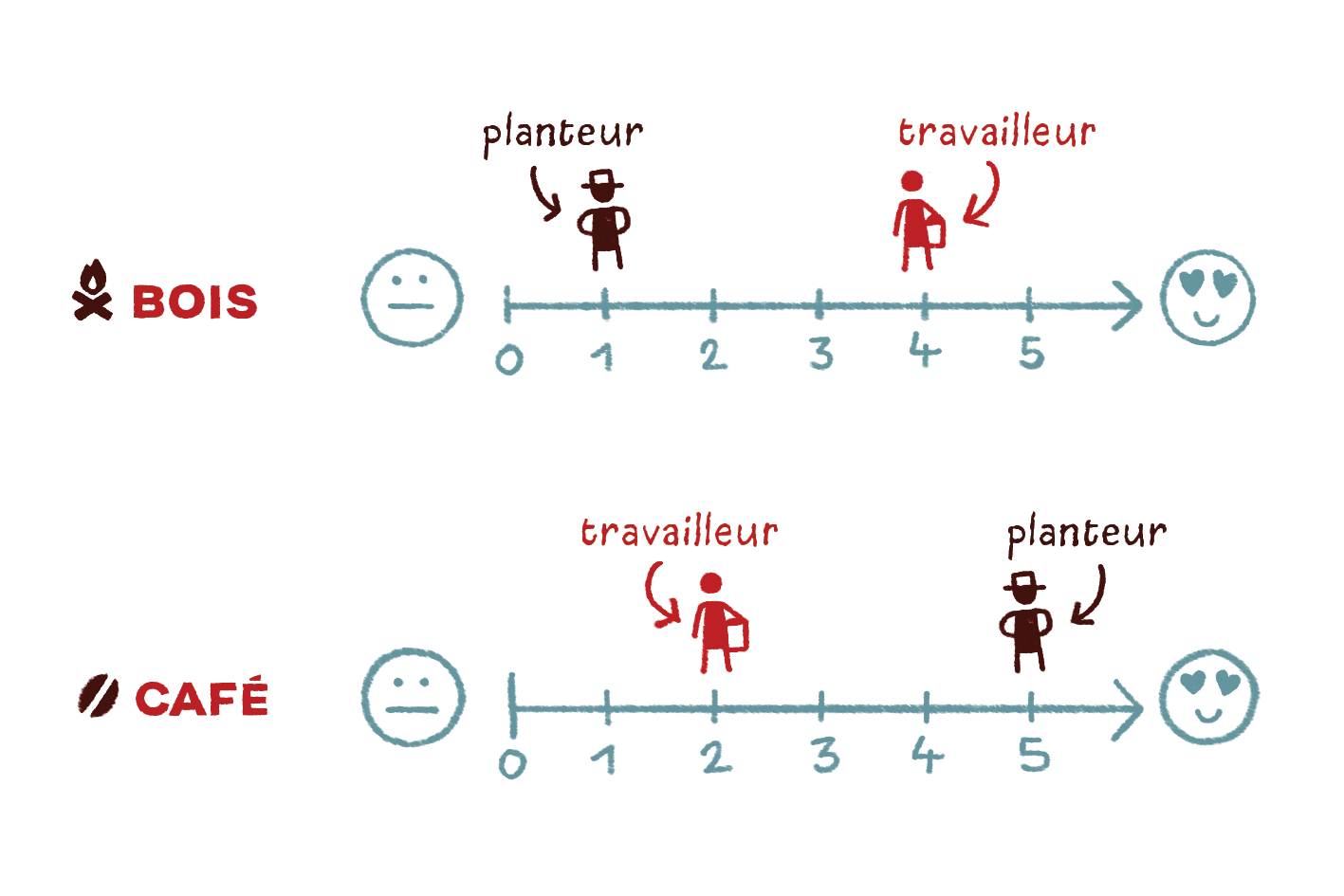
Differences in dependency on the resource according to the actors. Illustration by Sylvain Mazas.
In this way, we can map the dependency of different actors on different services provided by a territory. This allows us to make commonalities and divergences visible: who can form an alliance with whom? Who is likely to enter into competition? Who is most dependent on the territory?
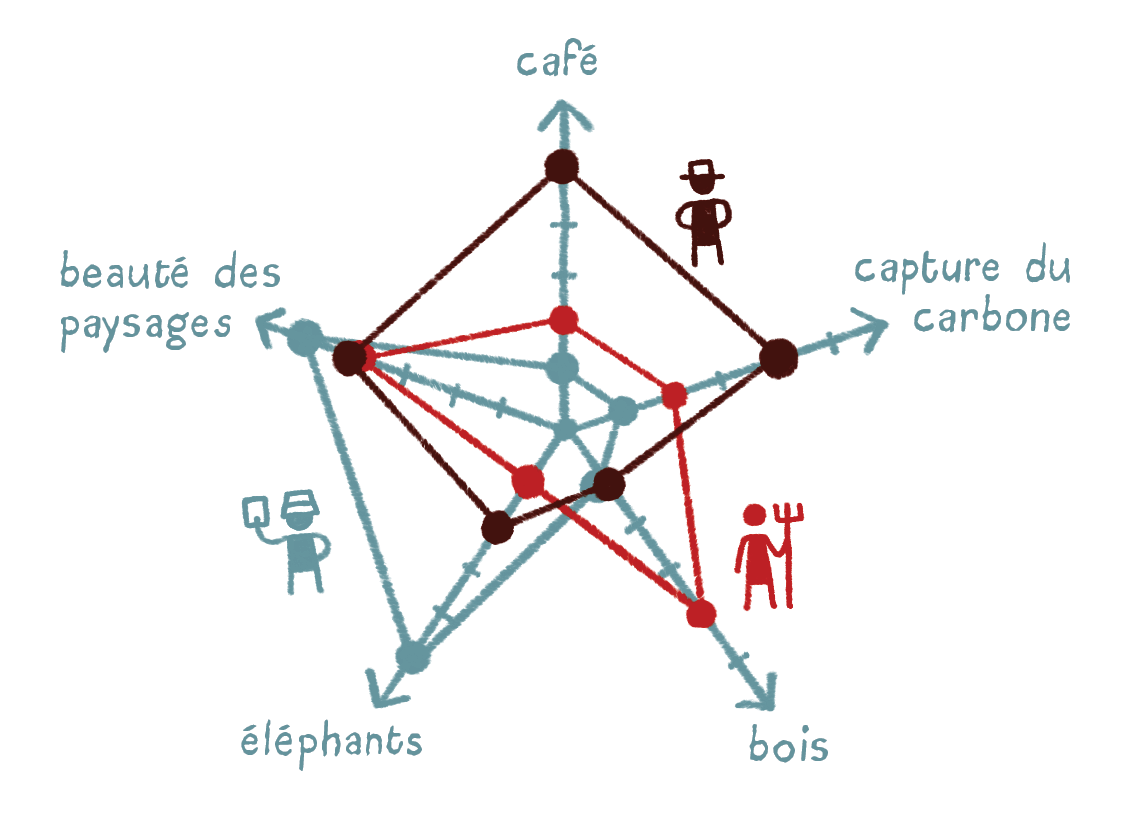
Differences in dependency on a territory’s services according to the actors. Illustration by Sylvain Mazas.
We can then track how these dependencies evolve and compare the interests of different actors under several possible futures. In a scenario favouring coffee plantations, or in another prioritizing forest protection, the winners and losers will not necessarily be the same depending on the service considered.
This is why I do not think we can talk about relationships with nature without also talking about power relations, interests and dependencies between actors. The language of ecosystem services does not make class interests disappear.
Ultimately, what does this change in the way we approach ecology?
We cannot simply document the disappearance of species. We need a more humanistic ecology, attentive to the humans at the heart of these systems, to their knowledge, beliefs, interests and room for manoeuvre. This is also how we can make action possible and effective.
To finish with an image, let’s talk about fruit. Ecologists have long been accused of being watermelons: green on the outside, red on the inside, as if ecology were merely “a cover for pushing through a communist programme3”.
As an ecologist, I would almost suggest the opposite. It can be useful to draw on certain analytical tools derived from Marxism, particularly its focus on classes, interests and power relations, not necessarily to adopt its political project, but to better understand why different social groups do not have the same relationships with, or interests in, nature.
In other words: red on the outside, green on the inside. Kiwis, in a way!
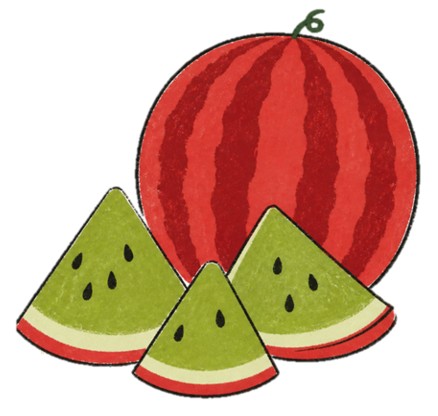
Ecology as a kiwi. Illustration by Sylvain Mazas.
_______________________________
Références dans le texte
1. Geist, H. J., & Lambin, E. F. (2002). Proximate causes and underlying driving forces of tropical deforestation: Tropical forests are disappearing as the result of many pressures, both local and regional, acting in various combinations in different geographical locations. BioScience, 52(2), 143-150.
2. Marx, Karl. 2008. Critique du programme de Gotha. Traduction de l’allemand par Sonia Dayan-Herzbrun ; appareil critique, bibliographie et index établis par Jean-Numa Ducange. Paris : Les Éditions sociales, coll. « GEME », 144 p.
3. Source : Actualité TFI Info “Gauche pastèque” : Olivier Véran a-t-il repris une expression “inventée par Jean-Marie Le Pen” ? par Caroline Quevrain. Publié le 25 juillet 2022.
Translation
This translation was made automatically from french, and may contain some phrasing errors.
See more
This interview originates from a conference given by Claude Garcia, member of the FRB’s Scientific Council, on his research.
References
Illustrations were made by Sylvain Mazas.
The picture used as a banner originates from Etactics Inc, Unsplash.
ouvrir/fermer
In text references
Other interviews
ouvrir/fermer
See more