The FRB in action
Biodiversity and climate, Biodiversity and oceans
Project ongoing since 2024
Cemarb_DC
Impacts of electromagnetic fields on the developmental biology and behaviour of the small-spotted catshark (Scyliorhinus canicula) in the context of offshore wind farm installations
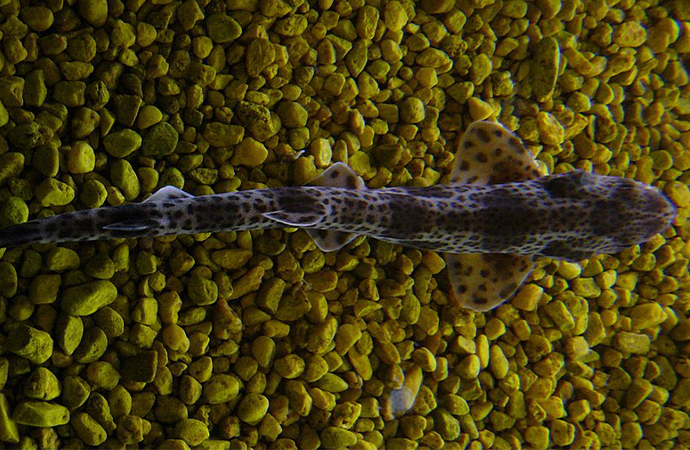 Petite roussette (Scyliorrhinus canicula)par Fernando Losada Rodríguez
 The Cemarb_DC project aims to identify and assess the effects of offshore wind farm grid connections to the mainland on elasmobranchs. The operational phase of wind farms can generate noise, vibrations, disruptions to ecological continuity, and electromagnetic fields around underwater electrical cables. These can affect the behaviour of electro- and magneto-sensitive species, which rely on “natural” electromagnetic fields for navigation and feeding. The proliferation of offshore wind farms risks amplifying these effects, while existing information on their consequences remains fragmentary.
The results will make it possible to (i) understand how elasmobranchs respond to electromagnetic fields of varying intensities, (ii) improve knowledge of the impacts of marine renewable energies, (iii) provide essential information to managers and decision-makers to address the challenges of developing marine renewable energies without harming the preservation of marine biodiversity.
To this end, early-stage (eggs) and juvenile small-spotted catsharks Scyliorhinus canicula will be exposed in controlled conditions to direct current electromagnetic fields of varying intensities corresponding to those measured along a distance gradient from grid connection cables. The impact of these fields is assessed by monitoring: survival, growth, development, aerobic metabolism and behaviour (level, type and duration of activity).
The researchers
Principal investigators:
Julie LUCAS – MNHN (France)
Thomas TRANCART – MNHN (France)
The Cemarb_DC project brings together specialists in (i) power supply for offshore wind farms, (ii) elasmobranchs, (iii) fish biology, and (iv) fish farming in controlled and experimental environments.
LE PROJET
The Cemarb_DC project stems from the Impact of Wind Energy call for projects. In partnership with Mirova Foundation, this call aims to better assess the impact of renewable energies on biodiversity and to produce operational recommendations for improved practices targeted at stakeholders in the sector.
The project selection process was carried out by a committee of independent experts.
partners and funders