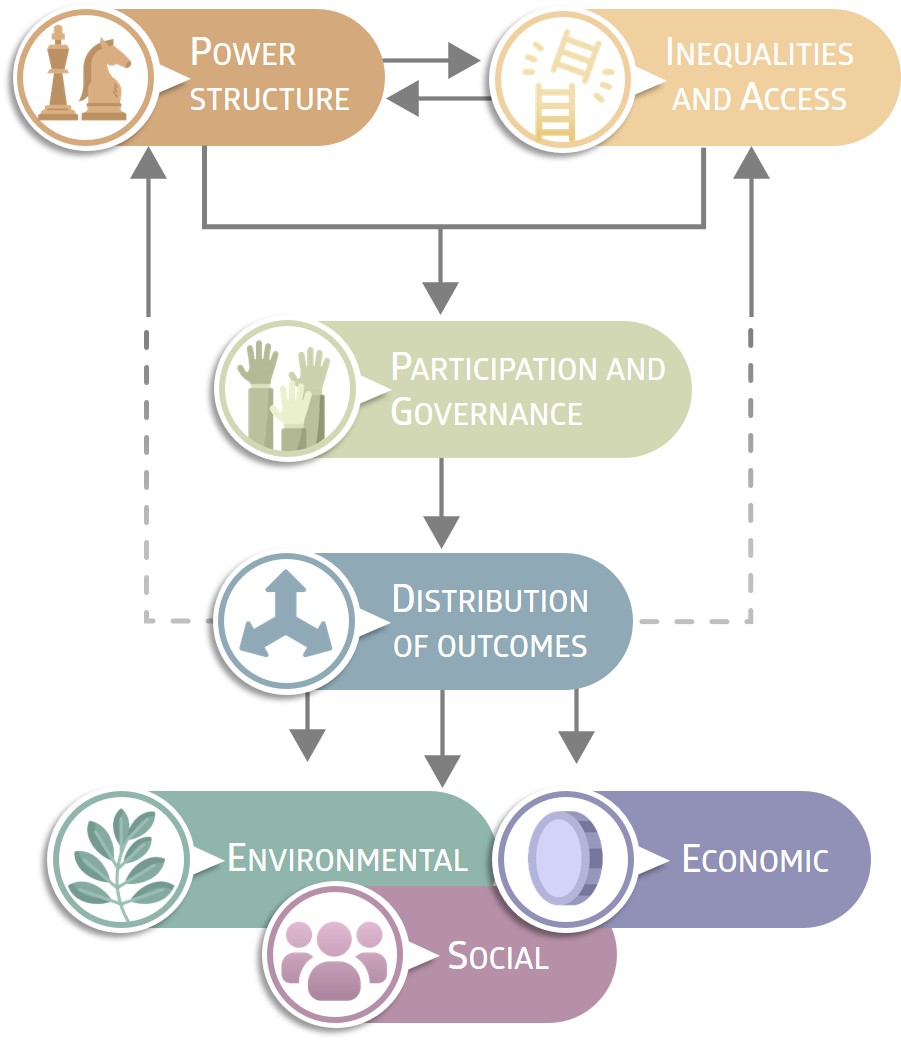
Traditional conservation approaches have typically focused solely on ecological aspects. However, a growing body of research shows that the success of conservation policies depends as much on governance, power dynamics, and underlying principles of justice as on the biological mechanisms they aim to protect. Despite this, the interactions between these dimensions remain poorly understood and are often studied in isolation.
Drawing on the findings of four FRB-CESAB research projects, this conference explores the emerging concept of Blue and Green Justice in biodiversity conservation. Each project used distinct methodological and disciplinary approaches, yet all shared a common goal: to examine how stakeholder engagement in conservation processes can strengthen the protection and resilience of terrestrial and marine ecosystems.

Learn more about the projects
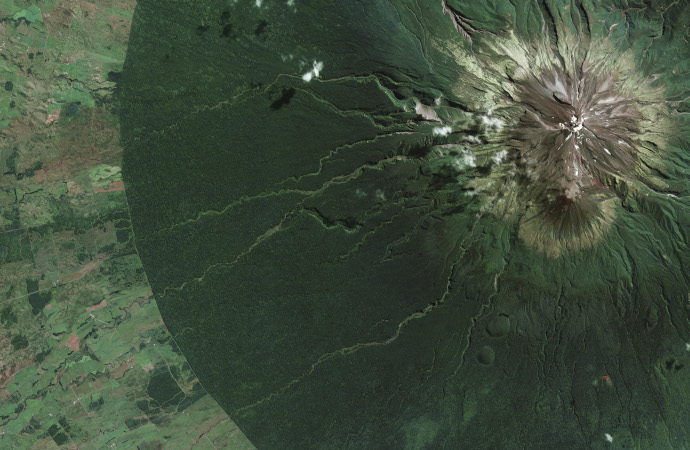
The program will begin with the PARSEC project, which combined satellite imagery, socio-economic data, and artificial intelligence to quantify the global impacts of protected areas, particularly on poverty. In parallel, PARSEC collaborated with the MPA-Poverty project — funded by the ANR and led by CEE-M — which resulted in a case study focused on fisheries in Tanzania.
The discussion will continue with the BLUE JUSTICE project, which explored the global connections between equity, marine policies, and the resilience of coastal communities, especially under the combined pressures of climate change, conservation, and development.
Complementing this, the JUSTCONSERVATION project synthesizes 50 years of empirical literature (662 case studies), providing robust statistical evidence that governance led by Indigenous peoples and local communities significantly improves ecological and social outcomes.
Finally, the POWERBIODIV project examines a dimension long theorized but rarely operationalized: power. Using a multidimensional framework combining systematic reviews, network analyses, and modeling, the project investigates how visible, hidden, and systemic forms of power influence participatory processes and their outcomes.
Participatory approaches are increasingly used in biodiversity conservation to build trust, reduce conflict, and create more lasting decisions. By bringing together diverse voices (local communities, scientists, policymakers, NGOs) they aim to shape strategies that protect both people and nature.
But more participation does not automatically mean better outcomes.
Power matters.
When power dynamics are overlooked, participation can become superficial, reinforcing old inequalities and even deepening tensions. Power shapes who is heard, whose knowledge counts, and who is left outside decision-making. If we don’t name and reflect on these dynamics, we risk failing the very goals of fairness and impact that participatory processes aim for.
This Tool for Thought invites conservation practitioners, researchers, and facilitators to reflect more consciously on how power operates in participatory settings and how we might respond with greater care and imagination. It introduces a shared vocabulary to talk about power clearly and constructively. It proposes key concepts, and reflective questions to help make power
more visible, more easy to talk about openly, and more actionable.
This resource is for anyone who works, or aspires to work, at the intersection between biodiversity, participation, and social change.
It speaks to:
But it also offers insights to those shaping the conditions for participation:
Rather than offering strict categories, this Tool for Thought invites a moreluid perspective: wherever you sit on the ground, in research, at policy levels, or inbetween, you are part of shaping how power flows through conservation efforts.
Associated content:
This booklet brings together a set of real-world case studies, each exploring how participatory processes unfold in conservation settings — and how power is entangled in every step.
Written by those directly involved in or observing these processes, these stories come from landscapes as varied as the Andes, the Pyrenees, the Scottish moors, and the forests of Mexico. They describe efforts to bring together communities, governments, scientists, and civil society actors to co-create responses to complex environmental challenges.
But more than technical achievements or policy innovations, these stories highlight the relational, emotional, and political dimensions of participation. They show that trust takes time. That silence and absence can be forms of power. That listening well matters. And that small shifts — a new question, a reframed agenda, a handwritten agreement — can carry the
seeds of transformative change.
These narratives were written in the context of the PowerBiodiv project, an initiative aimed at exploring how participatory biodiversity governance can be made more just and inclusive by attending explicitly to power. If you wish to learn more about the power framework and its different dimensions (visible, hidden, invisible and systemic power; power to, power with, power within, power for; spaces and level of power), we invite you to consult the accompanying handbook and visual tools developed as part of the same project.
We hope these stories invite you not only to reflect, but to stay in the room — and keep working toward more power aware and grounded forms of conservation.
Associated content
Over the past three decades, biodiversity conservation has expanded, from a focus on nature preservation alone, to more ‘people-friendly’ approaches integrating objectives for both conservation and human well-being, as visible in the governance of protected areas and other conservation measures worldwide. However, integrated approaches have not necessarily led to benefits to local people, giving rise to a further shift from a focus on economic development, to one on social justice. This FRB-CESAB research project called JUSTCONSERVATION analyzed how justice concerns find support and integration in biodiversity conservation; a research need which is currently under-addressed. It asks:
This document summarizes in a few pages the group’s context and objectives, the methods and approaches used, the main findings, as well as the impact for science, society, and both public and private decision-making.
To ensure the quality of our scientific content, we are currently finalizing the translation of this page.
It will be available for consultation very soon.
![[FRB-CESAB] Blue and Green Justice](https://www.fondationbiodiversite.fr/wp-content/uploads/2025/10/FRB-Cesab-Apercu-Conference-Justice.jpg)