Home >
Publications >
The Ocean Equity Index : the first tool to assess and strengthen equity in ocean governance
Biodiversité ! Le Média
Article
Publié : 28 January 2026
The Ocean Equity Index : the first tool to assess and strengthen equity in ocean governance
Lecture : 4 min
Sustainable Development Goals (SDGs), the United Nations Agreement on the High Seas (BBNJ) and the Kunming-Montreal Global Biodiversity Framework (GBF) have demonstrated strong commitment by governments and international organisations in recent years to social and environmental equity in ocean-related projects and decisions. However, progress is significantly hampered by a lack of clarity on how to define, measure, and monitor equity. To address this challenge, an Ocean Equity Index (OEI) has recently been developed and published in Nature by CNRS scientists as part of the FRB-Cesab Blue Justice project.
The OEI is the first global tool for measuring, comparing, and promoting equity in ocean-related initiatives, projects, and policies; it transforms an often abstract concept into a measurable and actionable standard. Marine protected areas, development programmes, and even entire economic sectors can be analysed and compared to promote initiatives and decisions that benefit coastal communities and marine ecosystems. It also helps identify gaps in rights recognition, participation, and benefit sharing.
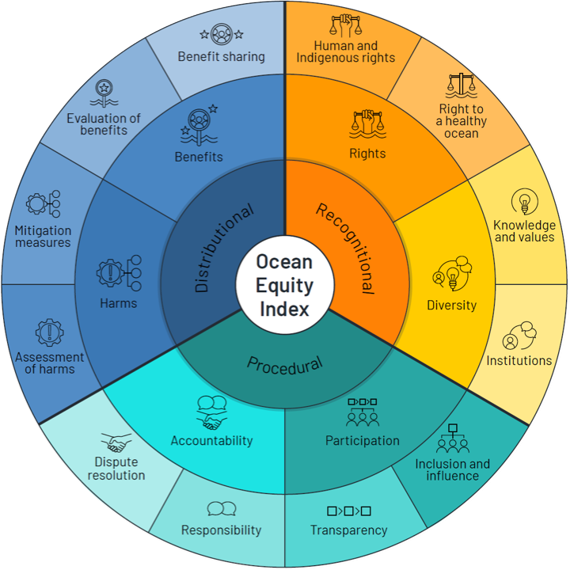
Representation of the twelve criteria of the Ocean Equity Index. © Joachim Claudet
The Ocean Equity Index is described in an article published on January 28 in Nature. Free and easy to use, this assessment tool is designed to be accessible to a wide range of stakeholders: local communities, Indigenous peoples, NGOs, scientists, industries, and governments. Available online via a dedicated website and offline through a calculation and visualisation form included in the publication, it assigns a score (from 0 to 3) to 12 criteria for each initiative analysed; the total score is expressed as a percentage of the maximum possible score.
Scientists are calling on governments and international organisations to quickly make use of this tool, as the benefits of ocean industries (aquaculture, maritime transport, offshore energy, etc.) are mostly concentrated in the hands of a few, main players at the expense of local populations and marginalised groups (Indigenous peoples, local communities, women and small-scale fishers) who also suffer the negative consequences of the exploitation of ocean resources.
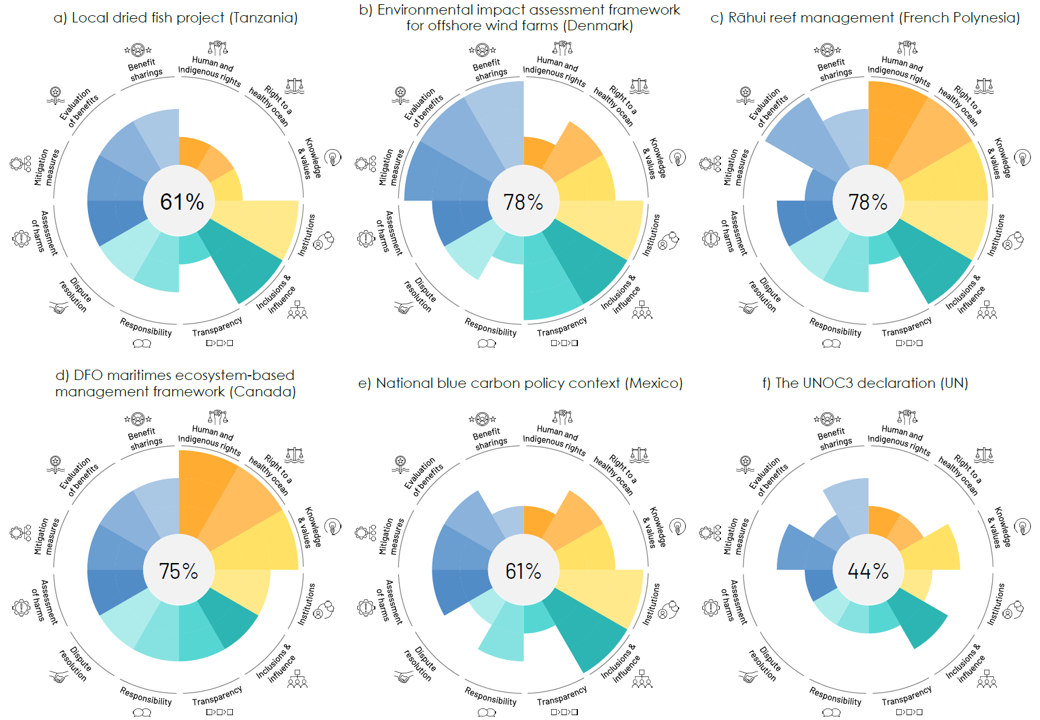
Examples of Ocean Equity Index ratings for various ocean-related projects and policies. © Joachim Claudet
Reference
The Ocean Equity Index. Jessica L. Blythe, Joachim Claudet, David Gill, Natalie C. Ban, Graham Epstein, Georgina G. Gurney, Stacy D. Jupiter, Shauna L. Mahajan, Sangeeta Mangubhai, Rachel Turner, Nathan J. Bennett, Stéphanie D’Agata, Phil Franks, Jacqueline Lau, Gabby Ahmadia, Mark Andrachuk, Pavanee Annasawmy, Victor Brun, Emily S. Darling, Antonio Di Franco, Louisa Evans, Natali Lazzari, Josheena Naggea, Veronica Relano, Maria C. Pertuz, Sebastian Villasante & Noelia Zafra-Calvo. Nature, 28 January 2026.
Contacts
Ressources
ouvrir/fermer
More information about the CESAB
ouvrir/fermer
More information about the CNRS
In partnership with