Home >
Publications >
Investigating wetlands: what dragonflies tell us
Biodiversité ! Le Média
Article
Publié : 30 March 2026
Investigating wetlands: what dragonflies tell us
Authors: Violette Silve & Lisa Nicvert
Reviewers: Pauline Coulomb & Hélène Soubelet
Lecture : 8 min
While the main European biodiversity indicators still rely heavily on birds and butterflies, the monitoring of wetlands, despite their essential role, remains less developed and less highlighted. Discreet and fleeting, dragonflies could emerge as key indicators of human impact on these interface ecosystems. This is the ambition of scientists from the group FRB-CESAB DRAGON, who recently published a study on the sensitivity of European species, laying the groundwork for a future operational bioindicator.
We barely notice them. A flash of blue above a pond, a lightning-fast trajectory through a garden, and they are already gone. Though discreet, dragonflies attract interest from a wide range of disciplines! Their flight performance inspires drones, their vision informs certain image-recognition algorithms, and the surface of their wings is studied to design antibacterial materials.
Beyond inspiring human innovation, their most valuable role may lie elsewhere, within their own environment. In recent years, one term has frequently been used to describe them: sentinels. This is no mere stylistic flourish. As silent witnesses to the state of ecosystems, ecologists are paying close attention to them…
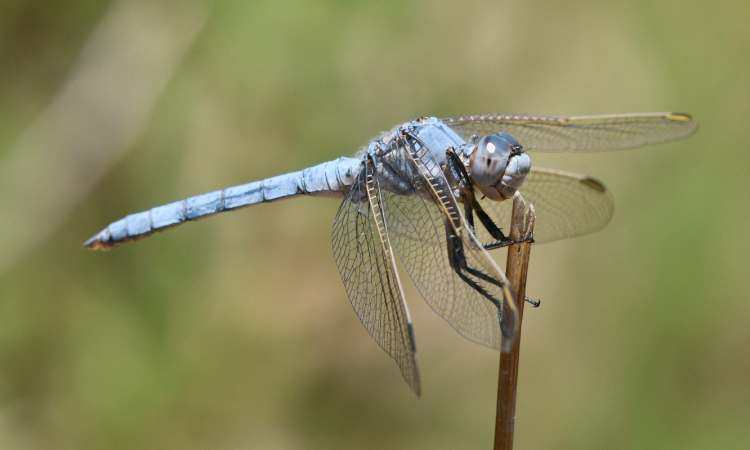
Roy Van Grunsven
Why dragonflies?
Dragonflies (or odonates), an order that includes damselflies and true dragonflies, have several characteristics that make them excellent indicators of ecosystem health:
- They have a short life cycle, split between two environments. They are a bit like icebergs – yes, stay with me, the comparison works! We tend to imagine them in their aerial form, but some species spend up to 90% of their lifespan in water as larvae.
- They are sensitive to environmental conditions: water quality, temperature, habitat availability…
- They play an important role in food webs as top predators of insects, both in their larval (aquatic) and adult (aerial) stages. They feast on the mosquitoes and gnats that bother us, but of course, they also serve as snacks for larger animals such as lizards or birds.
This combination makes them particularly responsive to disturbances. A change in water quality or climate can quickly lead to the disappearance of certain species. In other words, observing dragonflies is a bit like taking the pulse of an ecosystem.
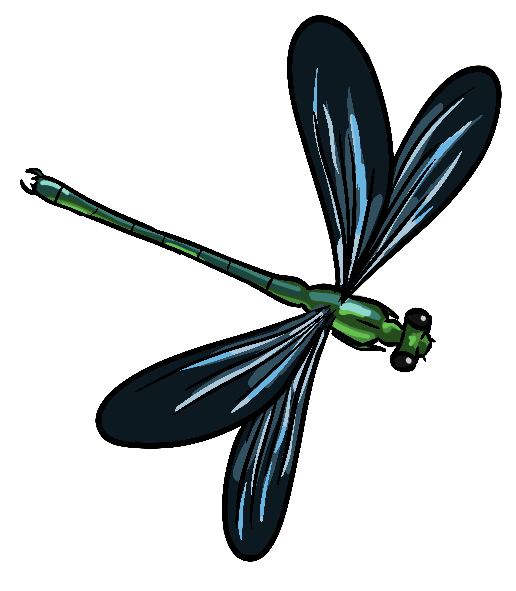
Lisa Nicvert
A study to understand their vulnerability
This potential is precisely what a recent study conducted by the FRB-CESAB DRAGON group explores, a research project stemming from the national “terrestrial biodiversity monitoring” programme set up by the Ministry for Ecological Transition (MTE) and the French Biodiversity Office (OFB). The researchers involved in the DRAGON project sought to understand why some species are more vulnerable than others, based on their biological characteristics, known as “traits.”
By analyzing 123 European species, they cross-referenced several vulnerability indicators (conservation status, population trends, distribution range) with about a dozen ecological and biological traits. This large dataset shows that these traits explain between 48% and 64% of the differences in vulnerability between species.
Three of these stand out in particular:
- Habitat type: species associated with specific environments, such as nutrient-poor waters or certain Mediterranean rivers, are more vulnerable. Among the factors explaining this vulnerability are chemical inputs that accumulate in these environments.
- Life cycle: species with longer development times are often more sensitive to disturbances.
- Thermal preferences: species adapted to colder temperatures or with low thermal tolerance are more threatened by climate change.
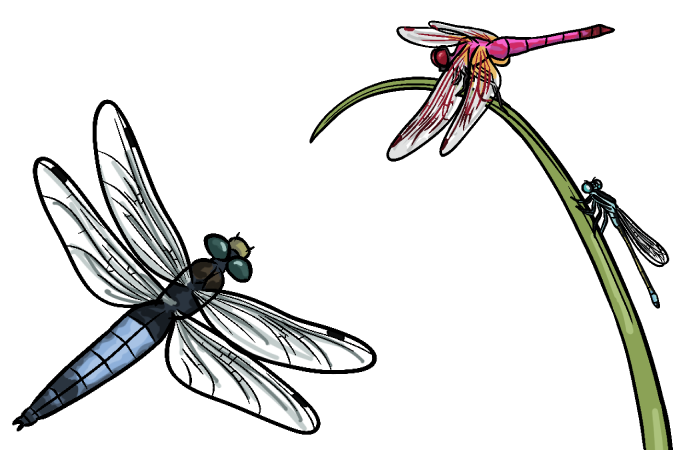
Lisa Nicvert
Towards a new operational bioindicator?
Identifying groups of species that share the same traits—and therefore the same vulnerabilities—makes it possible to better target conservation actions by directly addressing the environmental pressures that affect them.
In the long term, this approach could even lead to the creation of a multi-species indicator based on odonates, particularly relevant for aquatic and wetland environments, which are currently underrepresented in monitoring tools. Developing this new bioindicator is the goal set by the scientists of the FRB-CESAB DRAGON, to better understand and quantify human impact on interface ecosystems. Stay tuned for their progress! And perhaps the next time a dragonfly flashes across your field of vision, it will no longer be just a discreet insect, but a valuable clue to the state of an entire ecosystem.
References
- Photographs by Roy Van Grunsven
- Illustrations by Lisa Nicvert
Source article
Nicvert, L., De Knijf, G., Bowler, D. E., Bried, J. T., Coulon, A., Engel, T., van Grunsven, R. H. A., Jeliazkov, A., Lamouille-Hébert, M., Jeanmougin, M., Fontaine, C., & Schmucki, R. (2026). Linking species traits and vulnerability indicators in European Odonata. Biological Conservation, 317, 111786. DOI: 10.1016/j.biocon.2026.111786