Home >
Publications >
Storms and lakes: when algae turn back
Biodiversité ! Le Média
Article
Publié : 18 August 2026
Storms and lakes: when algae turn back
Author: Violette Silve (FRB-CESAB)
Proofreader: Pauline Coulomb (FRB), Orlane Anneville (Inrae)
Lecture : 6 min
A turquoise lake, a stormy sky, and everything changes. Swimming bans and algal blooms are the visible side of a far more complex and unstable balance than it may seem. Researchers from the FRB-CESAB GEISHA group reveal how storms, which are becoming increasingly frequent as a result of climate change, can disrupt the fragile balance of lakes, even making the phytoplankton communities that inhabit them “turn back the clock”.
Let’s set the scene. It is hot, and you are dreaming of a refreshing swim. But once you reach the lake you have been looking forward to, your blood runs cold. Horror! Swimming is forbidden! The culprits behind your disappointment are none other than tiny, well-known organisms: cyanobacteria. Their blooms can sometimes make swimming unsafe because they release toxins that pose health risks.
These microorganisms attract much of the attention, but they also reveal a broader phenomenon. Lake ecosystems can change abruptly in response to external disturbances, which is also why swimming is prohibited in many mountain lakes. For several years now, the FRB-CESAB GEISHA group has been investigating these unstable equilibria, with a particular focus on phytoplankton and how storms affect them. As climate change progresses, these extreme weather events are becoming more frequent and could strongly influence lake dynamics.
In 2021, we told you about their initial research. At the time, the links between storms and lake ecosystems remained unclear, but their work has since shed new light on an ecological phenomenon: reversion.
A clap of thunder and phytoplankton go back in time?
Phytoplankton communities, these microalgae that are essential at the base of aquatic food webs, undergo seasonal succession. Depending on temperature, light, and available nutrients, certain species become dominant. When a storm occurs, this cycle can be disrupted. This is known as reversion: phytoplankton communities return to an earlier state than expected, as if they were taking a leap back in time.
By analysing long-term monitoring data from eight large lakes, scientists discovered that these reversions are directly linked to physical changes induced by storms:
- In deep lakes: Storms disrupt the thermal structure by deepening the thermocline (the temperature transition layer — imagine the layer of cold water you feel around your legs when you go swimming) and increasing water mixing.
- In shallow lakes: Changes in water transparency are the key factor. A storm can, for example, dilute or disperse algae, making the water less clear.
As shown above with depth, there is no single response that applies to all lakes: each lake reacts differently depending on its characteristics. Season is also a determining factor: the same lake will not necessarily respond in the same way a few months apart. On average, only one storm out of three appears to trigger a reversion. This could reflect the natural resilience of phytoplankton, or simply an insufficient sampling frequency over the long duration of the study.
But why does it matter?
Disruptions to phytoplankton communities can throw the entire food web off balance, with potential consequences for biodiversity and human activities such as fishing, swimming, and access to drinking water. Predicting everything that can affect these sensitive ecosystems is no easy task, given that lakes are interconnected with their entire surrounding environment through runoff.
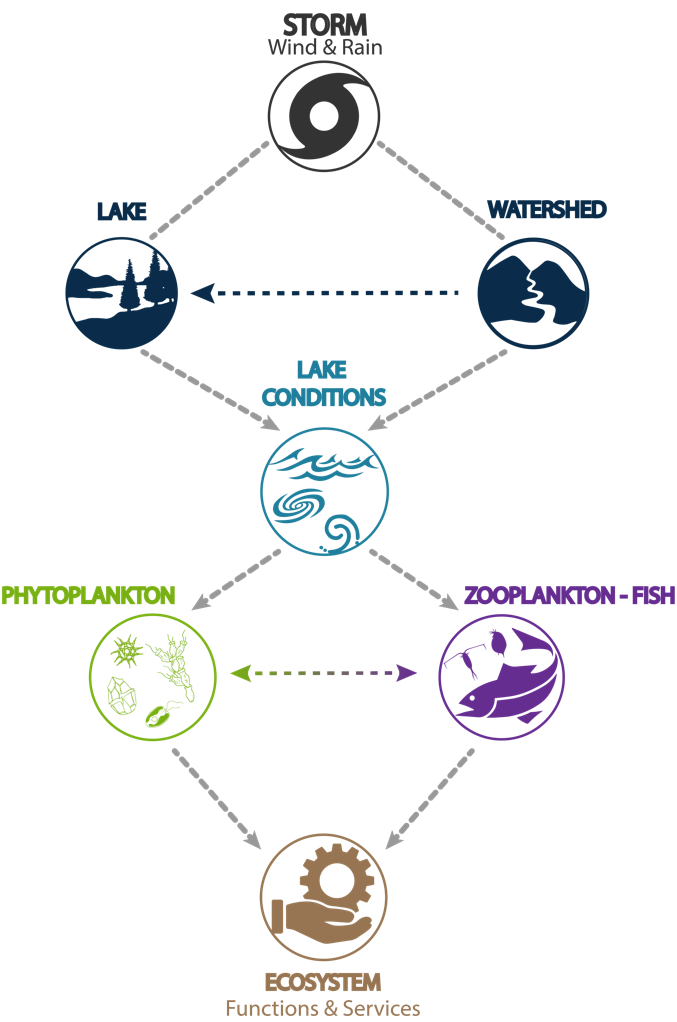
Fig. The impact of storms on lakes varies according to the lake’s geographical and morphological characteristics, its physico-chemical conditions, and the properties of its watershed. These factors act as filters that buffer or intensify the effects of storms. The response of phytoplankton (microscopic plants at the base of the food web) to a storm has important consequences for other components of the food web and for the ecosystem services provided by the lake. © Gaël Dur
Studying how storms influence these microscopic lake inhabitants may seem highly specialised (as many scientific studies can!). However, it is the combination of all these studies, each shedding a different light on the same complex problem, that enables us to move forward with confidence along the well-known path: understand, predict, and anticipate! And to do so, access to long-term datasets is essential. Only long-term ecological monitoring can reveal gradual or abrupt transformations in lakes and help adapt their management in the face of climate change.

Reference
Tran‐Khac, V., Doubek, J. P., Patil, V., Stockwell, J. D., Adrian, R., Chang, C., Dur, G., Lewandowska, A., Rusak, J. A., Salmaso, N., Straile, D., Thackeray, S. J., Venail, P., Bhattacharya, R., Brentrup, J., Bruel, R., Feuchtmayr, H., Gessner, M. O., Grossart, H., … Anneville, O. (2025). Using Long‐Term Ecological Datasets to Unravel the Impacts of Short‐Term Meteorological Disturbances on Phytoplankton Communities. Freshwater Biology, 70(5), e70023. https://doi.org/10.1111/fwb.70023
Photography by Péter Kövesi, Unsplash.
The GEISHA project
This work is the result of an international scientific effort initiated within the Global Lake Ecological Observatory Network (GLEON). GEISHA received funding from the USGS John Wesley Powell Center for Synthesis and Analysis, Université Savoie Mont-Blanc, Fulbright, and the Embassy of France in Canada (Mourou/Strickland Fellowship).
Translation
This translation was made automatically and may contain some phrasing errors.
Co-financeurs


Sur le projet Geisha