Communiqué
Publié : 16 July 2026
I Mis à jour : 17 July 2026
Beyond economic factors: The role of social behaviour in the establishment of protected areas
Lecture : 5 min
As countries have committed to protecting 30% of the world’s land and oceans by 2030 under the Kunming-Montreal Global Biodiversity Framework, a study published in Biological Conservation shows that differences between countries cannot be explained solely by economic or institutional factors. Conducted by Cathleen Petit-Cailleux, a postdoctoral researcher within the SPATMAN project, supported by the French Foundation for Research on Biodiversity (FRB) through its Centre for Synthesis and Analysis on Biodiversity (CESAB), and funded by the French Ministry for Ecological Transition (MTE) in partnership with the French Office for Biodiversity (OFB) through the programme “Anthropogenic Pressures and Impacts on Terrestrial Biodiversity“, the study highlights an association between certain social behaviours and the proportion of protected areas.
Collective behaviour as an explanatory factor
The researchers analysed data from 71 countries by combining international surveys on human behaviour with geographic data on protected areas.
Four behavioural dimensions from the Global Preferences Survey were examined: trust in others, altruism, patience, and willingness to take risks.
Only one of these traits showed a significant association: countries where individuals reported higher levels of trust in others tended, on average, to have a lower proportion of protected areas.
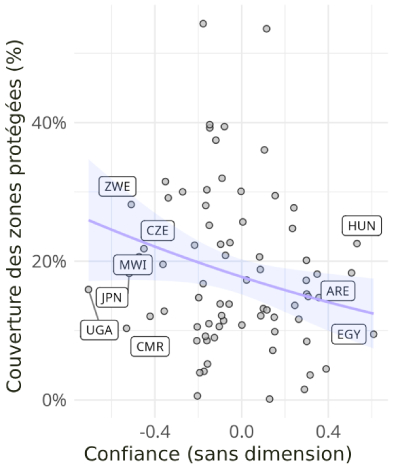
Figure. Negative relationship between trust in others and the percentage of protected areas. Each dot is a country.
One hypothesis put forward by the authors is that, in societies where interpersonal trust is high, the preservation of natural resources may rely more heavily on informal forms of cooperation, reducing the need for regulatory mechanisms such as protected areas. Conversely, in societies where distrust is more prevalent, biodiversity conservation may more often depend on formal institutional mechanisms.
However, the study focuses on the surface area of protected areas designated according to the criteria of the International Union for Conservation of Nature (IUCN), rather than on their actual conservation effectiveness. As such, it does not determine whether these areas genuinely achieve their biodiversity conservation objectives—a key issue in scientific debates, particularly given the existence of so-called paper parks (protected areas whose protection remains largely theoretical).
A new dimension to consider in conservation policies
These findings suggest that collective behaviour is one of many factors that may influence national conservation strategies. It complements other factors already identified—such as history, institutions, political priorities, and economic resources—that help explain differences in the proportion of protected areas across countries.
These results should not be interpreted as an argument for reducing the extent of protected areas in societies where trust is high. Rather, they reveal an association at the international level without establishing a causal relationship, and suggest that the behavioural characteristics of populations represent an additional dimension for understanding differences between countries.
The primary objective is to improve our understanding of how social factors may influence conservation choices. The study therefore encourages the development of conservation approaches that are better adapted to local social and cultural contexts, rather than assuming that a single model can be applied with equal effectiveness across all countries.
Further reading – Learn more about the Spatman project
Reference
Petit-Cailleux, C., Journé, V., & Dagorn, E. (2026). Human population behavioural traits matter for explaining terrestrial protected area coverage. Biological Conservation, 321, 111971. doi.org/10.1016/
Image credit: Rapha Wide, Unspash.
Contact
Writing: Violette Silve (FRB)
Reviewing: Pauline Coulomb (FRB), Cathleen Petit-Cailleux (FRB), Valentin Journé (Université d’Adam Mickiewicz et Université de Kyoto), Etienne Dagorn (University of Lille)
Translation
This translation was made automatically and may contain some phrasing errors.
Related contents
Financial support