The FRB in action
Biodiversity and climate
Project ongoing since 2024
Eolrap
Modelling the flight behaviour of raptors to improve avoidance and reduce the risk of collision with wind turbines.
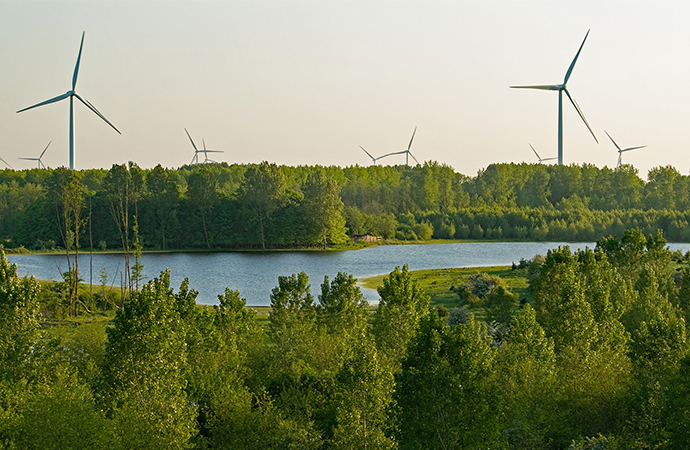
The Eolrap project aims to reduce the impact of wind energy infrastructure development on diurnal raptors, identified among the most vulnerable bird species. To this end, the project plans:
- to develop an application for wind energy developers and environmental authorities that identifies the spatial distribution and dimensions of wind turbines that minimise collision risk, depending on the species present in a given area, based on the modelling of flight behaviours obtained via GPS tracking.
- to assess the costs — i.e. the reduction in energy production — and the benefits — i.e. the reduction in collisions — of wind turbine shutdown strategies during periods (seasonal, daily, weather-dependent) when raptor flight is concentrated at blade height.
The Eolrap project builds on the doctoral thesis of Tonio Schaub: “Towards ecologically sustainable renewable energy production: Using detailed information on bird flight and ranging behaviour to mitigate the impact of wind farm development on bird populations“.
France currently has around 9,000 wind turbines producing 8% of the country’s energy consumption. In 2020, the Ministry of Ecological and Solidarity Transition announced that France’s goal was to double this capacity by 2028. The development of wind energy production will de facto lead to an increase in collisions with birdlife. The three-way collaboration of the Eolrap project, between an energy company and two universities, aims to limit this additional impact to a strict minimum.

To achieve this, the project team wishes to explore a set of measures aimed at avoiding collision risk through pre-installation thinking on the choice of sites and machine dimensions, as well as reducing this risk through post-installation measures involving a turbine curtailment strategy.
“We are indeed convinced that the solution lies in implementing a set of measures, tailored to the bird community present in a given environment, rather than seeking a single measure applicable everywhere.“
The researchers
Principal investigators:
Alexandre MILLON – Aix-Marseille Université, Imbe (France)
Caroline De ZUTTER– Engie Lab Crigen (France)
The Eolrap project will be led by postdoctoral researcher Tonio SCHAUB, in collaboration with Raymond KLAASSEN, a specialist in bird flight from the University of Groningen in the Netherlands.
The Project
The Eolrap project stems from the Impact of Wind Energy call for projects. In partnership with Mirova Foundation, this call aims to better assess the impact of renewable energies on biodiversity and to produce operational recommendations for improved practices targeted at stakeholders in the sector.
The project selection process was carried out by a committee of independent experts.
partners and funders