News
Publié : 27 January 2026
Interview with Aude Vialatte: New Scientific Director of the CESAB of the FRB
Scientific leadership plays a central role in the strategy of the CESAB, the FRB’s synthesis centre. In 2026, Aude Vialatte, Research Director at INRAE, joins the CESAB, thus succeeding Nicolas Mouquet, who has held the position since 2019. Let’s get to know her!
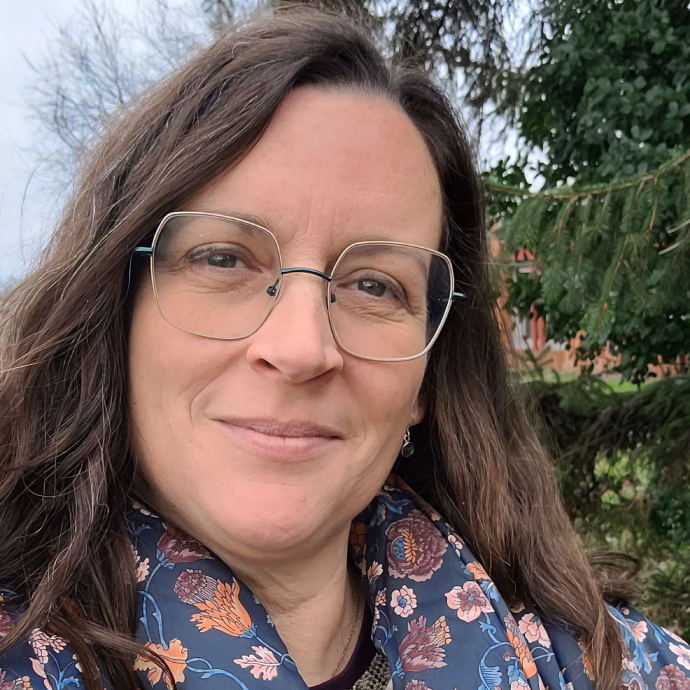
- Hello Aude, congratulations on your appointment as Scientific Director of the CESAB and welcome to the adventure! Could you please introduce your background and your field of scientific expertise in a few words?
I am delighted to be joining the CESAB, which offers truly ideal scientific working conditions for researchers!
I have been a Research Director at INRAE for a few years now, after spending 11 years as a lecturer-researcher at ENSAT (which later became AgroToulouse). My research focuses on agroecology, biodiversity, and collective action at the landscape scale. I take part in interdisciplinary projects combining ecology and social geography. I use semi-experimental and observational approaches, as well as spatially explicit modelling, to develop knowledge and tools that support changes in practices.
For example, I recently led a collective scientific assessment for government ministries on crop protection through plant diversification over a four-year period. Mobilising both fundamental theoretical knowledge and context-specific knowledge, this was an intense experience of interdisciplinary scientific synthesis within a group of 30 scientists, accompanied by rich and varied communication and dissemination activities.
I am currently completing my term as Unit Director of DYNAFOR, after eight years in its leadership as Deputy Director and then DU.
Working on the scientific strategy of an interdisciplinary research-action laboratory is both stimulating and enriching, with its management challenges and the responsibility of supporting colleagues and the collective.
- How did you come to know the FRB and its CESAB, and what motivated you to join us?
I know the CESAB, the FRB’s synthesis centre, in two ways. First, as a member of its Scientific Committee, with responsibilities that include advising on scientific strategy, organising calls for projects, selecting projects, and mentoring postdoctoral researchers.
Second, for the past year, as a member of a project hosted at the CESAB, with the unique experience of working under optimal conditions during one-week residencies with a group of colleagues on a scientific topic. It feels so good to experience these 100% scientific and convivial moments! This made me want to contribute to the long-term sustainability of the centre, all the more so given the biodiversity-related challenges.
- What would you like to develop during this term alongside us?
The CESAB is well structured and has an organisation that works well thanks to a committed, motivated, and motivating team!
The centre is well recognised within the scientific community in ecology. I mainly wish to develop the scientific themes of the nexus, as developed by IPBES and adopted by the FRB, which appear relevant for advancing ecological knowledge and strengthening the consideration of biodiversity-related issues, particularly to inform public policies. The challenge of diversifying financial resources in line with this thematic development is therefore an important one. Coordination with new research schemes, such as the PEPR, is also a current need associated with this mandate, as well as a genuine opportunity in the research landscape.