The FRB in action
Convention on Biological Diversity (CBD)
The FRB serves as a co-focal point for France to the body of the Convention on Biological Diversity (CBD) responsible for providing scientific advice—the Subsidiary Body on Scientific, Technical and Technological Advice (SBSTTA)—in conjunction with the French National Museum of Natural History (MNHN). In this capacity, it is part of the French delegation to the CBD, which is led by the ministry responsible for the environment and the ministry responsible for foreign affairs. The FRB thus actively contributes to advocating for French positions and encourages the French scientific community to support the development of these positions by coordinating a French network of experts for the SBSTTA.
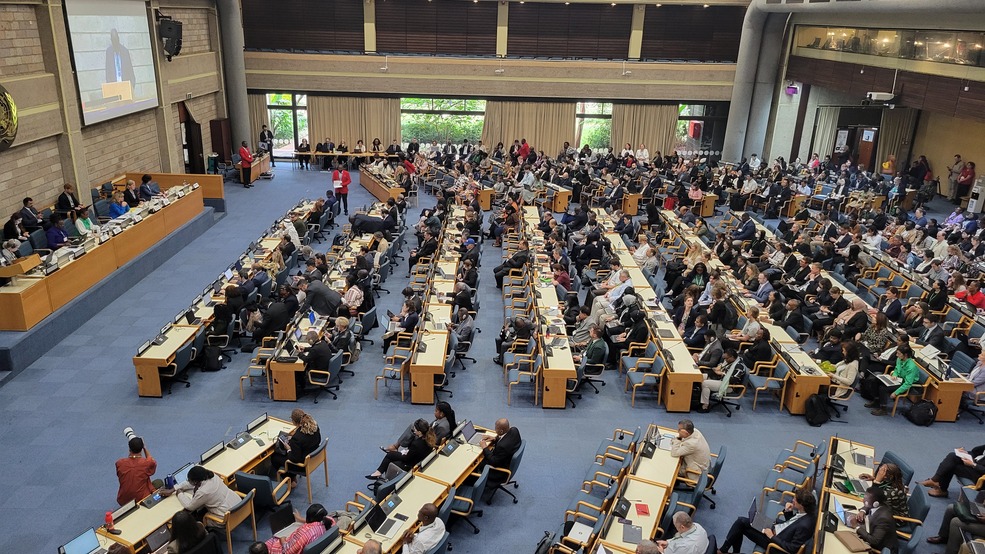
Plenary session during SBSTTA-28 in Nairobi, July 2026. Credits: Nathalie Morata.
As a French co-focal point for SBSTTA, the FRB’s role is to mobilize and convey French scientific expertise to inform French negotiators in the work of SBSTTA and the CBD. In collaboration with the MNHN, it coordinates a network of experts, promotes the synthesis of scientific knowledge, and facilitates its transmission to the negotiators.
What is CBD?
The Convention on Biological Diversity (CBD) is an international body under the auspices of the United Nations. It was established in 1992 at the Rio Summit (also known as the Earth Summit), alongside the United Nations Framework Convention on Climate Change (UNFCCC—which draws on the work of the IPCC) and the United Nations Convention to Combat Desertification (UNCCD). These three agreements are collectively known as the “Rio Conventions.”
Thirty years after its inception, in 2022, the 196 Parties to the Convention adopted the Kunming-Montreal Global Biodiversity Framework. This framework builds upon the lessons learned from the Aichi Biodiversity Targets (2010–2020) to continue the fight against the decline of biodiversity.
Adopted during COP15, this framework sets out goals for 2050 and targets for 2030, which nations have committed to achieving in order to halt and subsequently reverse biodiversity loss by 2030, with the ultimate aim of living in harmony with nature by 2050. Its implementation relies, in part, on scientific advice provided by the Subsidiary Body on Scientific, Technical and Technological Advice (SBSTTA), which is informed by the scientific knowledge and assessments of the Intergovernmental Science-Policy Platform on Biodiversity and Ecosystem Services (IPBES)—a body that compiles the latest evidence on the state of biodiversity and potential courses of action.
The French network of experts for the SBSTTA contributes to this dynamic by facilitating exchanges between national expertise and the needs of the delegation, with the aim of strengthening the quality of the positions France puts forward within the framework of the Convention. The network’s activities include online training sessions and thematic meetings, as well as support provided to experts by the two French SBSTTA focal points—work that is carried out in coordination and alignment with the French committee for IPBES.
Key figures and dates
- 1992 : Establishment of the CBD by 94 governments, under the auspices of several United Nations programs and organizations.
- 196 Parties
- 2022 : Adoption of the Kunming-Montreal Global Biodiversity Framework, running up to 2030
- 23 targets within the framework for 2030
- 4 goals within the framework for 2050
On the objectives of the CBD
The CBD has three objectives:
- the conservation of biodiversity;
- the sustainable use of its components;
- the fair and equitable sharing of the benefits arising from the utilization of genetic resources.
How the CBD Operates
The COP is the decision-making body of the CBD and meets every two years. Between each COP, the SBSTTA meets twice a year. Other subsidiary bodies—such as the Subsidiary Body on Implementation (SBI) and the body dedicated to indigenous peoples and local communities (Article 8(j) working group)—also meet between COPs. During these negotiations, states gather to discuss documents published by the CBD Secretariat at least six weeks prior to the meetings. If certain issues remain unresolved during the meetings of these subsidiary bodies, the relevant text is placed “in square brackets” and carried forward in that form to the COP, where states must then reach compromises and agree on a final text. The purpose of the SBSTTA is to examine the topics addressed within the CBD, based on the current state of scientific knowledge, in order to provide recommendations to states to support informed decision-making at the COP.
What are the outcomes of a COP?
Once decisions are adopted by states at a COP, they commit to implementing their content at the national level. This involves, among other things, incorporating the commitments made into their National Biodiversity Strategies and Action Plans. In France, this role is fulfilled by the National Biodiversity Strategy (SNB 3). The Convention on Biological Diversity (CBD) therefore serves to set common international goals, monitor their implementation (based on national reports submitted by countries), and adjust these goals and the level of ambition accordingly. Common objectives facilitate an “upward alignment” through the implementation of national policies for the protection, restoration, and sustainable use of biodiversity.
CBD Milestones
SBSTTA met for the 27th time in Panama in October 2025 and for the 28th time in Kenya in July 2026.
SB8(j) also met (for the first time) in Panama in October 2025.
SBI met in Italy in February 2026 and in Kenya in August 2026.
The 17th Conference of the Parties (COP-17) will be held from October 19 to 30, 2026, in Yerevan, Armenia.
The CBD-SBSTTA network
In light of growing biodiversity-related challenges and the increasing scrutiny faced by scientific expertise within multilateral forums, the FRB (French Foundation for Research on Biodiversity) aims to strengthen the engagement of the French scientific community in informing international negotiations and decision-making processes. This initiative aligns with the FRB’s mandate as the coordinating body for the French Committee for IPBES and as a co-focal point for France for the Subsidiary Body on Scientific, Technical and Technological Advice (SBSTTA). The SBSTTA network—co-managed with the French National Museum of Natural History (MNHN)—will rely on designated focal points and a roster of registered experts who can be called upon based on their specific areas of expertise, ensuring the seamless flow of information at the science-policy interface. Our goal is to foster an active, collaborative network designed to: i) enhance the participation of the French scientific community in intergovernmental processes; ii) mobilize researchers as needed for specific tasks such as analysis, peer review, or scientific support; iii) identify relevant scientific expertise in relation to topics on international agendas; and iv) facilitate opportunities for contribution and the efficient dissemination of requests for input.