Home > The FRB in action > The FRB’s programs & projects > Impact of renewable energy on biodiversity > Solar energy
The FRB in action
Solar energy
Impacts of ground-mounted photovoltaic power stations on wildlife, and the effectiveness of solutions and recommendations to minimise these impacts
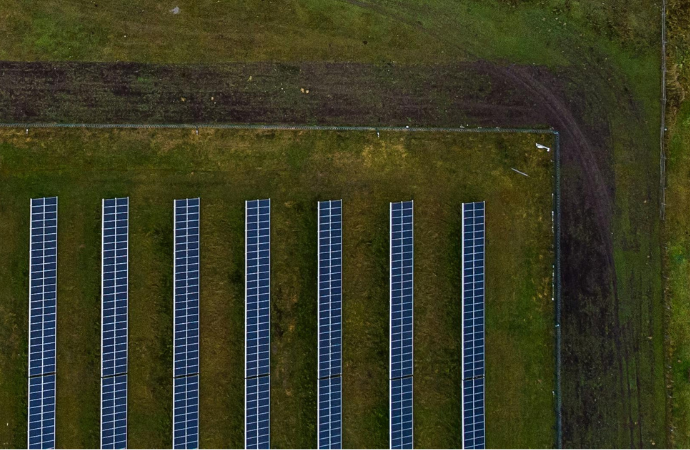
Ground-mounted photovoltaic development is accelerating in France as part of the energy transition aimed at achieving carbon neutrality by 2050. This trajectory involves increased electrification of end uses and the expansion of renewable energy sources. Ground-mounted photovoltaic power plants represenSélectionner un lient a strategic solution for producing large-scale decarbonized electricity. However, this development raises major environmental concerns, particularly regarding biodiversity. Ground-mounted installations occupy large areas, often in open, agricultural, or natural environments, and may have negative effects on wildlife, habitats, and ecological connectivity.
Impacts of ground-mounted photovoltaic power plants on biodiversity
Despite their silent operation and electricity generation without direct emissions, ground-mounted photovoltaic power plants can have a range of impacts on terrestrial wildlife. These effects concern a wide range of taxa, including birds, bats, insects, reptiles, amphibians, and mammals. Their magnitude varies depending on the local ecological context, the type of development, the management practices implemented, and the different project phases, including installation, operation, and decommissioning.
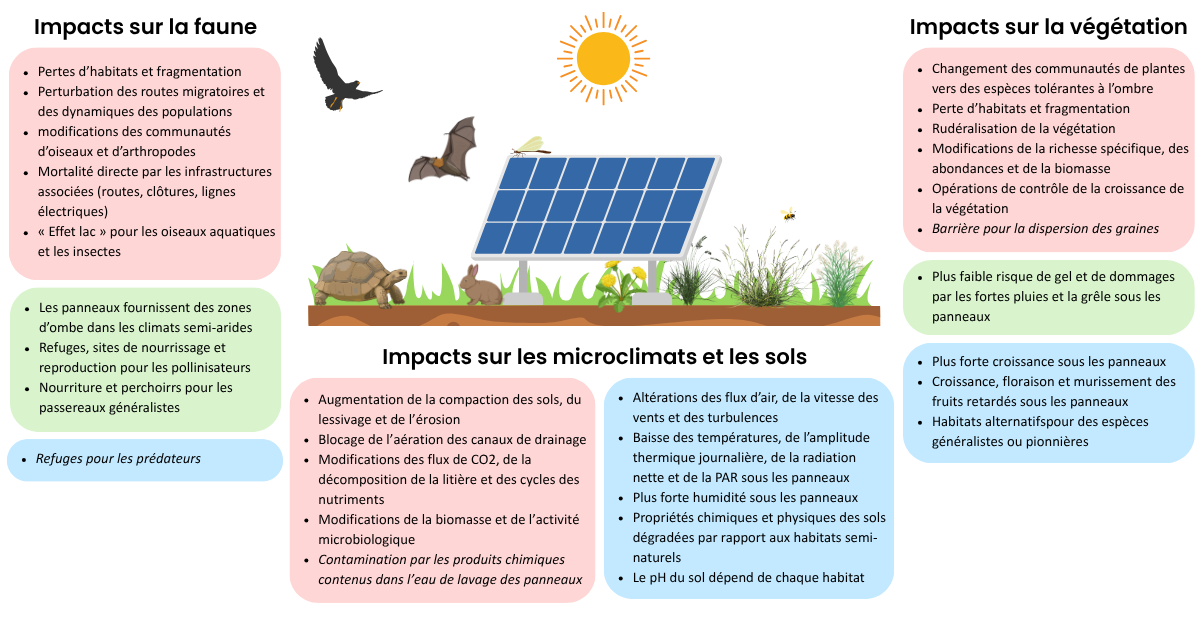
Red boxes indicate negative effects, green boxes indicate positive effects, and blue boxes indicate neutral, uncertain, or context-dependent effects. Potential impacts identified in the scientific literature but not yet demonstrated are shown in italics.
FOCUS ON
The Avoid–Reduce–Compensate (ARC) sequence:
A fundamental approach to managing the environmental impacts
of ground-mounted photovoltaic power plants.
In response to the identified impacts, French regulations require project developers to implement the ARC sequence throughout all stages of ground-mounted photovoltaic power plant development.
This principle, now at the core of environmental requirements, aims first to avoid significant impacts on biodiversity wherever possible, then to reduce impacts that cannot be avoided, and finally, as a last resort, to compensate for any remaining residual impacts.
AVOID I Avoidance is the priority step. It begins with spatial planning: projects should be located primarily on already developed or degraded land, such as parking lots, brownfield sites, or areas adjacent to infrastructure, in order to minimize pressure on sensitive natural environments. The implementing decree of the 2023 Renewable Energy Acceleration Act (known as the APER law) reflects this approach by excluding productive agricultural land and natural areas with high ecological value, except in justified cases. Avoidance also requires consideration of ecological corridors, nesting and overwintering sites for sensitive species, and the exclusion of projects located along migration routes or within wetlands.
REDUCE I Impact reduction relies on technical measures and site management practices. Good practices include wildlife-friendly fencing, the elimination of nighttime lighting, and sufficient panel height to facilitate species movement. Ecological vegetation management, such as late mowing or grazing, can also benefit pollinators and nesting birds. To limit visual attraction, less reflective or specially marked panels may be used. For bats, it is recommended that photovoltaic facilities be located away from roosts and wooded corridors, while preserving hedgerows and woodland edges. Acoustic and visual deterrent devices are also being tested.
COMPENSATE I Compensation, when required, remains a complex step and is still rarely implemented in practice. When necessary, compensation measures may include restoring open habitats near the project site, creating refuge habitats such as wetlands, flower-rich grasslands, or hedgerows, or funding targeted conservation actions. However, these measures must be tailored to the affected species and maintained over the long term in order to generate measurable ecological benefits. This therefore requires rigorous monitoring, which remains uncommon today.
_____
The effective implementation of the ARC sequence therefore depends on several conditions: coherent spatial planning, accurate baseline assessment tools, robust monitoring protocols, and regular evaluation of the effectiveness of implemented measures. These elements remain incomplete or unevenly applied. Today, the priority is to better assess the actual effectiveness of these measures.
The need to evaluate measures implemented to mitigate the impacts of ground-mounted photovoltaic power plants
In this context, measures aimed at mitigating the effects of installations on biodiversity are being increasingly adopted. However, their effectiveness remains poorly understood due to a lack of standardized data, a shortage of evaluated feedback and lessons learned, and limited knowledge-sharing at the national level. Among these measures are:
Habitat enhancement and biodiversity-friendly measures
In ground-mounted photovoltaic power plants, habitat creation or restoration involves transforming initially simplified areas, often consisting of lawns or former cropland, into more structured and diverse environments. The objective is to view solar parks as integral components of the landscape, capable of supporting diverse flora and fauna, rather than as primarily technical installations. In practice, this may include establishing flower-rich grasslands for pollinators, restoring degraded soils, maintaining taller vegetation or fallow areas, and adding landscape features such as hedgerows, woodland patches, or small wetlands.
Vegetation management through grazing
Using grazing animals to manage vegetation in ground-mounted photovoltaic power plants can provide an alternative to purely mechanical maintenance practices such as mowing or mulching. The aim is to reduce external inputs, limit disturbance, and potentially benefit certain components of biodiversity, particularly soil fauna. However, the actual effects of these practices remain poorly documented in the context of ground-mounted photovoltaic facilities.
Modifying infrastructure design and layout
Changes to the design and layout of ground-mounted photovoltaic power plants (mounting systems, spacing between panel rows, fixed versus tracking technologies) can strongly influence local microclimatic conditions and, consequently, soil invertebrate communities. These design parameters may serve as potential levers to reduce biodiversity impacts or, conversely, as factors that could exacerbate disturbances in already fragile environments. Our literature review identified only one study addressing the effects of photovoltaic power plants in relation to these design aspects, providing an initial insight into this category of mitigation measures.
Solar panel surface treatments
The texture, patterns, coatings, and light-reflecting or polarizing properties of photovoltaic panels strongly influence their interactions with wildlife. Solar panel surface treatment consists of modifying panel surfaces through the use of lines, grids, matte or anti-reflective coatings, microtextures, or wires in order to reduce reflectivity and attractiveness to wildlife.
Acoustic deterrence
Acoustic deterrence remains a relatively unexplored mitigation option in the context of ground-mounted photovoltaics, where interactions between installations and birdlife are less documented than in the wind energy sector. The principle involves emitting sound signals perceived as disturbing or threatening in order to reduce the presence of birds near infrastructure.
The solutions presented in this publication have demonstrated a degree of effectiveness in specific studies limited to particular contexts and species.
Recommendations for reducing risks to biodiversity
Better documenting these measures, identifying the most effective ones, and structuring monitoring efforts have become shared priorities among public authorities, developers, land managers, and the scientific community. This report provides a synthesis of recommendations organized around three major themes and specifically developed for these three groups of stakeholders.
🔎 RESEARCH
☑️ Expand the range of study contexts: By covering a broader diversity of environments, including arid, Mediterranean, and tropical ecosystems, particularly across mainland France and its overseas territories.
☑️ Rebalance research efforts across taxa: By developing dedicated studies on pollinators, birds, bats, as well as small and large mammals, reptiles, and amphibians.
☑️ Diversify the types of measures studied: By moving beyond panel surface treatments and habitat-focused measures alone, and also testing vegetation management, fence permeability, deterrent devices, infrastructure design, and compensation measures.
☑️ Strengthen methodological robustness: By prioritizing, whenever possible, BACI-type approaches (Before-After-Control-Impact), multi-year monitoring, independent replication, and explicit consideration of confounding factors.
🛠️ METHODOLOGY
☑️ Standardization: Greater standardization would be beneficial. Harmonizing protocols (sampling areas, monitoring frequencies, response indicators) and reporting formats (basic statistics, uncertainty estimates, detailed methodological descriptions) would facilitate comparisons across studies and support future meta-analyses.
☑️ Transparency: Greater transparency regarding funding sources and potential conflicts of interest, as well as the sharing of raw data whenever possible, would strengthen confidence in results and enhance their reusability.
📝 MANAGEMENT
☑️ Embed evaluation within projects themselves: Every implementation of a measure (vegetation management, design adaptations, panel modifications, fencing improvements, compensation actions) represents an opportunity to integrate structured monitoring with an appropriate comparator. Photovoltaic parks can thus become genuine experimental sites for testing and comparing measures under real-world conditions at limited additional cost. Achieving this requires closer collaboration between developers, environmental consultants, site managers, and researchers.

Ressources
ouvrir/fermer
Access the bibliographic portal
More information
This publication was produced as part of the programme “Impact of renewable energy on biodiversity”. This research project funding programme led by the Foundation for Biodiversity Research (FRB) and the Mirova Research Center aims to better assess the impact of renewable energy on biodiversity and to produce operational recommendations on best practices for stakeholders in the sector. More information
Resources - Impacts
Related topics Back to the programme page
Avec le soutien de