Home > The FRB in action > The FRB’s programs & projects > Impact of renewable energy on biodiversity > Offshore wind energy
The FRB in action
Offshore wind energy
Impacts of offshore wind farms on biodiversity and recommendations for risk assessment.
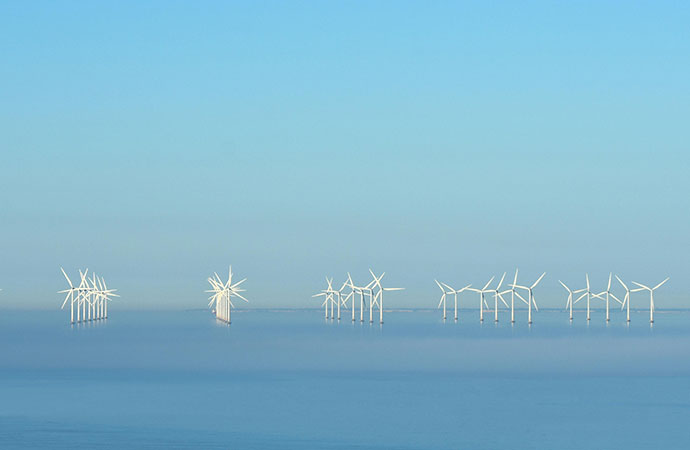
Since the deployment of the first offshore wind installations, controversies have emerged regarding their economic and environmental costs and benefits.
In the face of the climate emergency, the rapid reduction of greenhouse gas emissions is essential. As electricity generation from fossil fuels is one of the main sources of CO₂ emissions, the energy transition towards renewable energy plays a key role in achieving carbon neutrality by 2050.
Offshore wind energy, meaning wind energy generated at sea, appears to be a strategic solution to meet the growing demand for decarbonized electricity, diversify the energy mix and strengthen national energy autonomy. Nevertheless, despite its climate benefits, offshore wind energy requires substantial infrastructure that can disrupt the environment in which it is installed.
Focus on the impacts of offshore wind installations on biodiversity
Offshore wind energy therefore poses major environmental challenges, particularly regarding biodiversity: disturbances in the water column and to benthic habitats, meaning seabed environments, noise emissions that may harm marine mammals, as well as disturbances in the air column with collision risks for birds and bats, etc.
Numerous research studies have therefore sought to assess the positive and negative impacts of these infrastructures on biodiversity and the functioning of marine ecosystems, generating a substantial body of scientific literature. These impacts vary greatly depending on the life cycle of the installation, its location, the type of turbine used, the type of foundations and anchoring systems, associated structures, and the species present that interact with these infrastructures. These installations are mainly located within wind farms, of varying size and at varying distances from the coast. However, coastal areas are both zones of high biodiversity and culturally rich territories where the sharing of land, sea and resource uses represents a major challenge.
Recommendations to reduce risks to biodiversity
In accordance with Target 15 of the Kunming-Montreal Global Biodiversity Framework, all economic actors must reduce their negative impacts on biodiversity, including the impacts of solutions designed to mitigate climate change. Energy production, like other human activities, must therefore transition towards more sustainable practices while preserving biodiversity. To support this transition and reduce the impacts of offshore wind energy, recommendations are proposed for the scientific community, offshore wind developers and operators, and governments.
Among these measures are:
Spatial planning
The spatial planning of offshore wind farms is a major lever for preventing ecological impacts on seabirds and migratory bats. The body of research reviewed converges toward a precautionary and collaborative approach based on data. This planning relies on several complementary pillars:
- First, the collection and sharing of robust data provide the foundation for informed siting decisions. These rely on targeted studies, standardized monitoring protocols and open collaborative platforms.
- Next, impact assessment tools — whether mapping, statistical or model-based — make it possible to anticipate risks and identify the most vulnerable areas for flying wildlife. Strategic project siting, including the exclusion of sensitive areas, the creation of buffer zones and the protection of migratory corridors, reinforces this preventive approach.
- Finally, at a finer scale, micro-siting allows adjustments to the internal configuration of wind farms to improve ecological permeability while optimizing energy efficiency.
Temporal planning
Temporal planning is a pragmatic mitigation measure that complements spatial planning. Based on the biological rhythms of sensitive species, it allows project timelines to be adjusted so that the most intrusive phases occur outside critical periods.
Available data show that disturbances during critical periods can lead to notable ecological effects, such as reduced reproductive success or changes in foraging behavior. In response, carefully timed interventions appear to be a promising preventive tool. This approach requires detailed knowledge of local species and rigorous ecological monitoring.
Turbine curtailment
Whether general or targeted, adaptive or predictive, the different curtailment strategies appear to be essential tools for effectively reducing the impacts of offshore wind farms on flying biodiversity. However, their operational success requires a thorough understanding of the behavior of the species concerned, as well as rigorous and continuous evaluation of their effectiveness under real conditions. Three conditions are therefore necessary:
- Deploy next-generation detection technologies;
- Generalize site-specific behavioral and environmental monitoring;
- Establish integrated and collaborative management at regional and international scales.
In the long term, these approaches will not only significantly reduce the ecological risks associated with offshore wind energy, but also improve the social and economic acceptance of these projects from a long-term sustainability perspective.
Turbine visibility
Measures aimed at improving the visibility of wind turbines are based on a precautionary and anticipatory approach: the objective is to design infrastructures that are more perceptible to sensitive species, drawing on a detailed understanding of their sensory ecology and flight behavior.
Identified actions include lighting management, the introduction of strong visual contrasts, the selection of less attractive colors, and the adaptation of turbine physical dimensions, such as ground clearance or rotor diameter.
These measures, largely derived from interdisciplinary research combining sensory ecology, engineering and flight biomechanics, still require empirical validation in marine environments.
For operators, these elements provide avenues for technical innovation compatible with safety requirements and regulatory constraints. For scientists, they open an essential field of applied research to evaluate species–infrastructure interactions. For decision-makers, they reinforce the idea that designing biodiversity-friendly wind farms requires the careful integration of ecological knowledge into technical choices.
In this perspective, turbine visibility emerges as a complementary lever for risk reduction, to be considered alongside other more structural measures such as micro-siting, curtailment or spatial planning.
Deterrence measures
Deterrence measures designed to limit interactions between flying wildlife and offshore wind turbines remain a relatively immature field of experimentation. Most of the identified devices — acoustic, light-based, textured or electromagnetic — originate from terrestrial trials and remain largely undocumented in marine environments. Their effectiveness varies depending on species, with a risk of rapid habituation. Some solutions, such as ultrasound or anti-perching systems, appear promising but still require testing at sea, while others, such as lasers, coatings or UV lighting, remain at the experimental prototype stage.
In this context, deterrence devices should be considered potential complements to more established measures (spatial planning, micro-siting, curtailment). Their future development will depend on investment in applied research, closely linked to ecological knowledge of the species concerned and to offshore operational constraints. For developers and decision-makers, this is therefore an area to monitor closely, by supporting pilot projects and scientific validation programmes in order to determine whether certain solutions can be operationally integrated into the next generations of offshore wind farms.
Wind farm repowering
Repowering offshore wind farms represents an emerging opportunity to better integrate biodiversity considerations into the long-term management of offshore infrastructures. By enabling spatial and technological reconfiguration of wind farms, this phase offers the possibility of applying targeted mitigation measures such as micro-siting or removing high-impact turbines, based on improved knowledge accumulated over time.
However, for this strategy to become a real lever for reducing impacts on birds and bats, it requires the establishment of robust and continuous ecological monitoring protocols capable of identifying the most problematic turbines. Yet the availability of detailed offshore data remains a major challenge today. The success of repowering as a mitigation tool will therefore depend on increased investment in offshore environmental monitoring and on governance frameworks that encourage the active use of these data in project reconfiguration phases.
Compensatory measures
Compensatory measures represent a last-resort tool in the hierarchy of mitigation strategies, designed to offset the residual impacts of offshore wind farms on birds and bats once avoidance and reduction options have been fully implemented.
Their implementation relies on a variety of complementary approaches: habitat restoration, targeted conservation actions and strategic planning.
These measures must be carefully planned, adapted to the species concerned and evaluated over the long term to ensure that they effectively compensate for the ecological losses generated. Initiatives such as the removal of invasive predators, the creation of protected breeding colonies or the funding of alternative conservation programmes offer concrete pathways to strengthen the resilience of affected populations.
However, their success is associated with significant uncertainty and depends on strict conditions: rigorous monitoring, interregional coordination and integration into a broader environmental strategy. It is therefore essential that compensatory measures are not perceived as a substitute for avoidance efforts, but rather as a targeted complement, implemented with caution, transparency and within a long-term conservation perspective.

Ressources
ouvrir/fermer
Access the bibliographic portal
More information
This publication was produced as part of the programme “Impact of renewable energy on biodiversity”. This research project funding programme led by the Foundation for Biodiversity Research (FRB) and the Mirova Research Center aims to better assess the impact of renewable energy on biodiversity and to produce operational recommendations on best practices for stakeholders in the sector. More information
Resources - Solutions and recommendations