The FRB in action
Biodiversa+
Biodiversa+ is the European Partnership for Biodiversity, established under the European Green Deal and co-developed with the European Commission. Launched in 2005, this partnership is renewed on a seven-year cycle. Active for the period 2021–2028, Biodiversa+ has a budget of over €800 million, of which €165 million is funded by the Commission.
It supports international research with a direct impact on public policy and society, with the goal of restoring biodiversity by 2030 and living in harmony with nature by 2050.
The partnership brings together more than 80 organizations in 40 countries (funding agencies, ministries, research institutes and environmental bodies) and creates a framework for cooperation linking science, policy and practice to support the transition to a sustainable and resilient Europe.
Biodiversa+ focuses on five strategic objectives that constitute the key levers for strengthening the impact of the partnership:
- Generating actionable knowledge to combat the direct and indirect drivers of biodiversity loss and ecosystem degradation
- Improving the monitoring of biodiversity and ecosystem services across Europe
- Strengthening the factual database and facilitating the large-scale development and deployment of Nature-based Solutions (NbS)
- To provide scientific methodologies for assessing ecosystem services and natural capital
- Providing scientific support for the development of biodiversity-related policies at European, national and international levels
FRB and Biodiversa+
The FRB hosts most of the Biodiversa+ operational team and ensures the network’s day-to-day coordination. It plays a central role in facilitating, monitoring, and ensuring the coherence of activities carried out by partners.
In addition, the FRB also makes its strategic expertise available to the partnership to lead or co-coordinate several key tasks of the partnership
- Private sector integration (Work package 3)
– Implementation of actions aimed at intensifying joint research and innovation programming between public actors and businesses, in order to promote a more effective integration of biodiversity into economic models and investment decisions
– Creation of success stories highlighting methods and indicators to assess the impacts and dependencies of companies on biodiversity.
- Knowledge summaries (Work package 4)
– Coordination of the production of summaries on priority issues. This work helps to identify knowledge gaps, guide future flagship programs and provide support for public policies.
– Creation of success stories showing the use of research results to inform public decisions.
- Internationalization (Workpackage 5)
– In connection with the Intergovernmental Science-Policy Platform on Biodiversity and Ecosystem Services (IPBES), Biodiversa+:
-
- supports the production of new knowledge to fill the gaps identified in IPBES assessments
- organizes capacity building activities at European level
– In connection with the Convention on Biological Diversity (CBD), Biodiversa+:
-
- trains European researchers to raise their awareness of CBD processes
contributes to the promotion and enhancement of scientific knowledge produced in Europe
- trains European researchers to raise their awareness of CBD processes
– In connection with the Intergovernmental Science-Policy Platform on Biodiversity and Ecosystem Services (IPBES)
- Communication and distribution (Workpackage 6)
– Steering and developing communication strategies to make the results of the partnership visible and accessible.
– Organizing the dissemination of knowledge produced and promoting open science, in order to facilitate its reuse by decision-makers, the scientific community and civil society.
Finally, the FRB co-leads, with the ANR and the Ministry of Research, the French Mirror Group of Biodiversa+. This Mirror Group’s main missions are to help define France’s scientific policy and commitment within this European partnership, and to generate interest among research organizations, universities, partner agencies and private partners, encouraging them to actively contribute to the partnership.
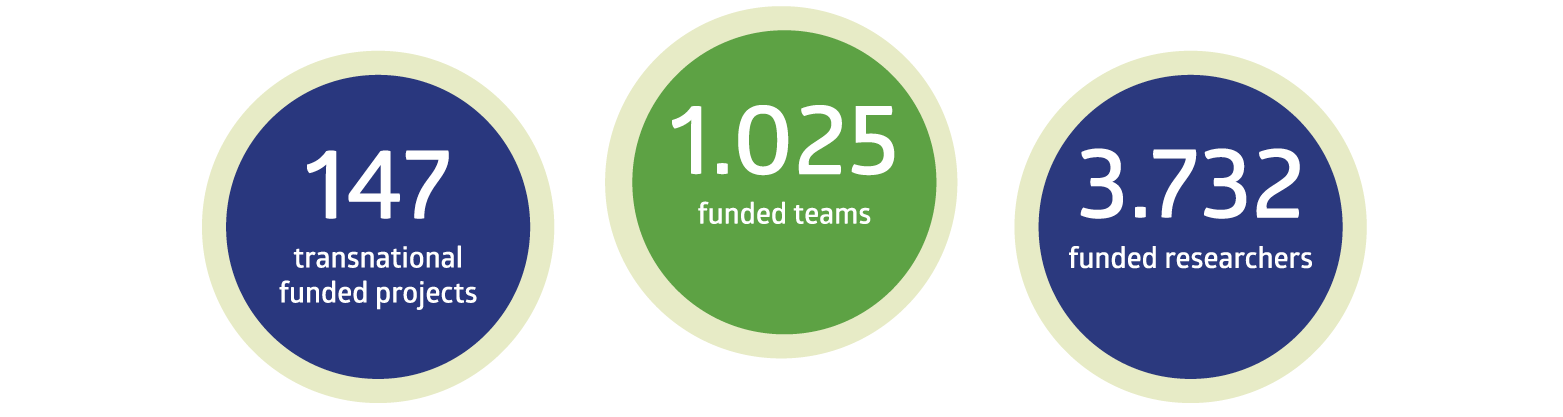
From 2008 to 2021: funding granted by BiodivERsA
More information about Biodiversa+
Visit the Biodiversa+ website , and through:
· the summary on Biodiversa+ (ENG);
· the strategic agenda for research and innovation of Biodiversa+ (ENG);
As well as on:
LinkedIn , Bluesky, Mastodon, and YouTube
• To receive live updates from the network, subscribe to the partnership newsletter (ENG)

FRB contacts
Operational team:
Part of the Biodiversa+ operational team is hosted within the FRB. This team ensures the coordination of the partnership, the management of the network and the implementation of key actions with European partners.
Violaine Dory,
Operational Manager “Finance and Administration”
Anna Sandor
Operational Manager “Governance”
Cloé Durieux,
Program Officer, Support for the coordination of activities and monitoring of partnerships.
Chloé El Achi
Administrative and Financial Coordinator, Financial management, reporting and European compliance.
Tatiana Thomas,
Stakeholder Engagement Officer,Organizing dialogues with decision-makers, field actors and European networks.
Typhaine Quinquis,
Internationalization Project Manager, Development of collaborations with international platforms and initiatives.
Mithila Unkule
Project Manager “private sector and nature-based solutions”, Support for co-programming actions between research and businesses.
FRB team involved in key Biodiversa tasks:
Julie de Bouville
Biodiversa+ (WP6) Communications Leader, In charge of success stories (WP3&4)
Marie-Claire Danner
In charge of the link with IPBES (WP5)
Camille Guibal
In charge of the link with the CBD (WP5)
Joseph Landridge
in charge of knowledge syntheses (WP4)
Constance Laureau
in charge of business relations (WP3)
Nathalie Morata
In charge of the French mirror group (WP9)
The FRB is involved in European projects and programs through Biodiversa
- BiodivScen
BiodivScen is a programme jointly launched by BiodivERsA and the Belmont Forum and co-funded by the European Commission. It aims at promoting research on scenarios of biodiversity and ecosystem services.
FRB is in charge of the coordination of the programme and hosts the BiodivScen Secretariat. FRB is thus particularly active in the management of administrative aspects, as well as in science-society / science-policy interfacing activities centred around the international research projects funded through BiodivScen.
For more information on BiodivScen.
- BiodivClim
BiodivClim is a programme launched by BiodivERsA which is co-funded by the European Commission and aims at promoting research on biodiversity and climate change.
FRB hosts the Secretariat for the BiodivClim program and is, as such, particularly active in the management of administrative aspects as well as in science-society / science-political interfacing activities around international research projects funded within the framework of the action.
Fore more information on BiodivClim.
- BiodivRestore
BiodivRestore is a programme jointly launched by BiodivERsA and the Water JPI which is co-funded by the European Commission. It aims to promote research on the conservation and restoration of degraded ecosystems and their biodiversity.
FRB is in charge of the coordination of the programme and hosts the BiodivScen Secretariat. FRB is thus particularly active in the management of administrative aspects, as well as in science-society / science-policy interfacing activities centred around the international research projects funded through BiodivScen.
Fore more information on BiodivRestore.
- IPBES technical support units (TSUs)
IPBES technical support units (TSUs) are teams mobilised by IPBES Secretariat to support whether IPBES task forces or authors for an assessment in the implementation of their work programme. The TSU on knowledge and data was created to support the IPBES task force on knowledge and data in the implementation of its mandate: since 2019, BiodivERsA is co-hosting the TSU for the “knowledge generation” part, while the Senckenberg Institute (Frankfurt) addresses issues related to the data part. Regarding knowledge, the objective is to catalyse the generation of new knowledge based on gaps identified in IPBES assessments. To do so, the task force developed a three-step process:
Step 1: supporting assessments’ authors in the knowledge gaps’ identification process;
Step 2: promoting the uptake of identified gaps by engaging relevant external organisations and institutions;
Step 3: monitoring and follow up of how new knowledge effectively fills identified gaps.
- ThinkNature
ThinkNature is a platform of 17 European partners, including BiodivERsA, aiming at better understanding and promoting Nature-based Solutions.
Through BiodivERsA, FRB is monitoring the outputs of the platform and contribute to feed the platform.
THE THEMES CALLS OF BIODIVERSA SINCE 2008
- 2021-2022 – Biodiversa+ joint call co-funded by the European Commission on « Supporting the protection of biodiversity and ecosystems across land and sea »
- 2020-2021 – Joint Call between BiodivERsA and Water JPI and co-funded by the European Commission on « Conservation and restoration of degraded ecosystems and their biodiversity, including a focus on aquatic systems »
- 2019-2020 – Join Call co-funded by the European Commission on “biodiversity and climate change”
- 2018-2019 – Biodiversity and its influence on animal, human and plant health
- 2017-2018 – Joint call between the Belmont Forum and BiodivERsA, co-funded by the European Commission on “Scenarios of biodiversity and ecosystem services”
- 2015-2016 – Joint call co-funded by the European Commission on the following themes:
- Theme 1 – Understanding and managing the biodiversity dynamics of soils and sediments to improve ecosystem functioning and delivery of ecosystem services
- Theme 2 – Understanding and managing biodiversity dynamics in land-, river- and sea-scapes (habitat connectivity, green and blue infrastructures, and naturing cities) to improve ecosystem functioning and delivery of ecosystem services
- 2013-2014 – Promoting synergies and reducing trade-offs between food supply, biodiversity and ecosystem services (Joint call between BiodivERsA and FACCE-JPI)
- 2012-2013 – Invasive species and biological invasions
- 2011-2012 – Biodiversity scenarios, identifying tipping points and improving resilience
- 2010-2011 – Biodiversity and ecosystem services and their valuation
- 2008 – Biodiversity: linking scientific advancement to policy and practice
Ressources
Policy briefs
- How natural forest expansion in Europe can offer cost-effective benefits to people (ENG);
- Planning and managing networks of Marine Protected Areas in a changing climate (ENG);
- How soil biodiversity can strengthen resilience and ecosystem services in agricultural landscapes (ENG);
- Small scale fisheries and co-management schemes (ENG);
- Green infrastructure within agricultural landscapes strengthens the supply of ecosystem services (ENG) ;
- Policy tools to manage synergies and trade-offs between ecosystem services (ENG);
- The Common Agricultural Policy can strengthen biodiversity and ecosystem services by diversifying agricultural landscapes (ENG);
- Action on invasive alien species should better anticipate climate change effects on biological invasions in Europe (ENG);
- Measures to increase ecosystem resilience and avoid tipping points (ENG);
- Wildlife diseases on the increase (ENG);
- Conservation of threatened insects in Europe (ENG);
- Natura 2000 and Europe’s forests (ENG);
- Conservation of small mammals and associated ecosystems” (ENG);
- Nitrogen pollution and climate change reduce carbon storage and biodiversity of peatlands (ENG);
- Adaptation of trees and forests to climate change: the importance of genetic variability (ENG).