The FRB in action
“Families for Positive Biodiversity” Challenge
Launched in 2021 by the National Federation of Regional Natural Parks, the “Positive-Biodiversity Family Challenge” (Défi Famille à biodiversité positive) project aims to support families who wish to reduce their biodiversity footprint in their daily lives. Through a fun and educational approach, families take on a series of thematic challenges. As part of a broader effort to address the preservation of the natural world, the project provides scientific knowledge to participating families and explores the connections between consumption, daily behaviors, and their impact on biodiversity.
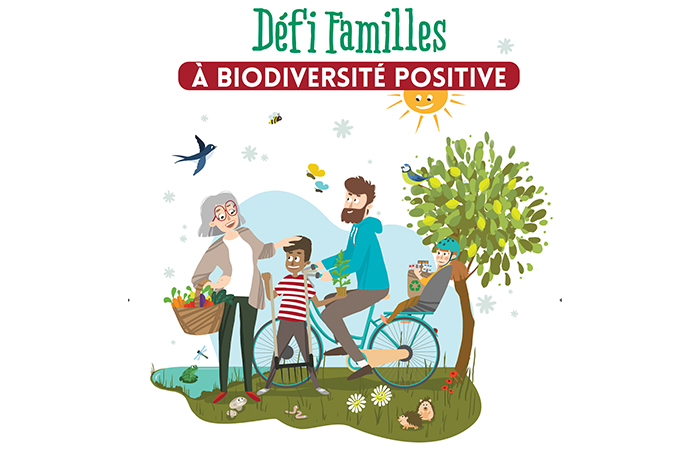
Since 2022, the Foundation for Research on Biodiversity (FRB) has been providing scientific and technical support to the National Federation of Regional Natural Parks (FNPNR) regarding the methodology for the “Positive Biodiversity Families Challenge”
Launched in 2021 by the FNPNR, the “Positive Biodiversity Families Challenge” project aims to support families living within regional natural parks who wish to reduce their biodiversity footprint in their daily lives. Through a fun and educational approach, participants take on a series of thematic challenges.
Aligned with efforts to address the challenges of preserving the living world—and rooted in the need for transformative changes in both individual and collective behavior—this project is led by the network of Regional Natural Parks of France and is supported by the French Office for Biodiversity (OFB) and RTE.
🔎 A closer look at the “Family Challenge” initiatives
The “Biodiversity-Positive Families Challenge” concept is an innovation inspired by various existing “Family Challenge” initiatives, such as the “Zero Waste” challenges launched by Zero Waste in 2016, the “Positive-Food Households” program launched by a network of organic producers in 2012, and “Déclics”—formerly the “Positive-Energy Families Challenge“—which was launched by the association Prioriterre in 2008 and is coordinated by the energy transition network, Cler.
From 2024 through 2027, this initiative is also part of the LIFE BIODIV’FRANCE program and receives financial support from the European Union and the Ministry for Ecological Transition, Biodiversity, Forests, the Sea, and Fisheries.
The FRB, scientific partner of the Challenge
A number of partner organizations, brought together within a national steering committee, contribute to the co-creation, development, and dissemination of the “Families for Positive Biodiversity Challenge” (Défi Familles à biodiversité positive). Among these partners, the French Foundation for Research on Biodiversity (FRB) and the Centre for Functional and Evolutionary Ecology (CEFE) provide scientific support for the Challenge.
This support takes the form of thematic guidance sheets designed for the Challenge’s facilitators, which provide a scientific explanation of the links between our consumption patterns, our daily actions, and their impacts on biodiversity. This work also includes suggestions for practices that benefit biodiversity. Based on recent data from both scientific and “grey” (non-peer-reviewed) literature, these sheets cover various topics, such as “getting around and biodiversity,” “eating and biodiversity,” “gardening and biodiversity,” and more.
Families can also self-assess to estimate and calculate their “biodiversity footprint” using self-diagnostic tools developed by the FRB. Taking this a step further, the Foundation is working on a “narrative” approach to these self-diagnostics: a landscape-based representation of their footprint will be presented to participating families, offering a more intuitive and evocative perspective on their final score.
Finally, we sought to present the final self-diagnostic score through a compelling narrative. To this end, we have developed a landscape-based representation of each family’s biodiversity score. Once the questionnaire on the digital platform is completed, users can explore a French landscape and see how it is altered by their daily consumption choices—an artistic way to illustrate the five pressures on biodiversity identified by IPBES.
Gradual nationwide rollout of the scheme
As part of the LIFE program—co-financed by the European Union and steered by the French Office for Biodiversity (OFB)—the gradual, nationwide rollout of this framework, both within and outside Regional Natural Parks (PNRs), has become a strategic objective for the National Federation of Regional Natural Parks (FPNR).
Since 2022, the Foundation, in collaboration with the FPNR, has facilitated a “Biodiversity Footprint” working group. Its goal is to integrate the “Challenge” methodology into the City of Paris’s 2025–2030 biodiversity plan, thereby extending the application of this approach beyond the Regional Natural Parks. The initial phase involves testing the framework in the city’s priority neighborhoods—specifically within two schools that feature “Oasis Schoolyard” projects. By coordinating this working group, the French Foundation for Research on Biodiversity (FRB) is fostering strategic ties between the City of Paris, the Paris Council for Architecture, Urban Planning, and the Environment (CAUE), and the National Federation of Regional Natural Parks to support the implementation of this pilot.
Support at a glance
Phase 1 of the support process:
- Scientific and technical guidance provided by the FRB (French Foundation for Research on Biodiversity) to the National Federation of Regional Natural Parks regarding the methodology for the “Positive Biodiversity Families Challenge” (*Défi familles à biodiversité positive*).
- Development of thematic biodiversity framework sheets for the Challenge’s facilitators, and creation of self-assessment questionnaires for families to evaluate their own impact on biodiversity.
2nd stage of the support process:
- Scientific support for the creation of a digital platform—developed by the agency Natural Solutions—that allows individuals to calculate their own biodiversity footprint.
- Development of a landscape-based representation of families’ biodiversity footprints, linked to the five pressures identified by IPBES.
3rd stage of the support process:
Facilitation of a “Biodiversity Footprint” working group, aimed at integrating the challenge’s methodology into the City of Paris’s 2025–2030 Biodiversity Plan, and participation in the rollout of this methodology beyond the Regional Natural Parks.
👉 Refer to Action 2 under Objective 88, “Carry out targeted initiatives for audiences disconnected from nature,” or the Biodiversity Plan Summary.
More info
👉 View the information brochure for the “Families for Positive Biodiversity” Challenge
Avec le soutien de